Chapter 38 — Government Policies to Achieve Efficient Resource Allocation and Correct Market Failure
Cambridge International AS & A Level Economics (9708) · Unit 8.4 · 4th edition coursebook
Learning objectives
- Explain how a range of tools can be used to correct the different forms of market failure, including specific and ad valorem indirect taxes, subsidies, price controls, production quotas, prohibitions and licences, regulation and deregulation, direct provision, pollution permits, property rights, nationalisation and privatisation, provision of information and behavioural insights and 'nudge' theory.
- Evaluate the effectiveness of the tools used to correct market failure.
- Define the meaning of government failure in microeconomic intervention.
- Explain the causes and consequences of government failure.
Key terms
- regulations
- A wide range of legal and other restrictions that come from government or regulatory bodies.
- property rights
- Where owners have a right to decide how their assets may be used.
- pollution permit
- A form of licence given by governments that allows a firm to pollute up to a given level.
- provision of information
- When governments directly provide information to correct market failure.
- production quota
- A physical limit on what can be produced.
- 'nudge' theory
- Influencing choice by 'nudging' individuals towards making more effective decisions.
- nationalisation
- When a government takes over a private sector business and transfers it to state ownership.
- government failure
- Where government intervention to correct market failure leads to a net loss of economic welfare.
38.1Government policies to correct negative and positive externalities
Many forms of market failure arise from externalities (Sections 32.6 and 33.3). In principle the free market mechanism should produce the best allocation of resources, but in practice it often does not, so government intervention is needed to support and correct the market. The main interventions used to address externalities are specific and ad valorem indirect taxes, subsidies, regulations, pollution permits, property rights, and the provision of information (see Figures 38.2, 38.3, 38.5 and 38.6).
Negative production externalities
Negative production externalities are spillover costs imposed by producers on third parties — for example a firm illegally discharging toxic waste, over-use of pesticides contaminating water supplies, or urban traffic congestion that worsens air quality for everyone breathing the urban air.
Specific and ad valorem indirect taxes
One way to correct the externality is to tax activities where too much is being produced. The indirect tax — often called a Pigouvian tax — should ideally equal the marginal external cost so that the externality is internalised: firms pay for the costs they impose on third parties. With an ad valorem green tax on a polluting product, the MSC curve diverges further from MPC as output rises (because the tax is levied on the quantity of output). The price paid by consumers rises by less than the tax (the rest is borne by producers, who accept a lower net price), and the market output falls to the socially efficient quantity.
In practice the big problem is estimating the correct tax. Putting a realistic monetary value on the cost of air pollution or a contaminated water supply is very difficult. If the tax is set below the marginal external cost, the market failure is only partly corrected; if it is set above, output is too low and another inefficiency arises. A second problem is that a green tax has little effect when demand for the taxed product is price inelastic — diesel fuel, for example, is essential for owners of diesel-engine vehicles, so most of the tax falls on consumers without changing behaviour much. International competitiveness is also relevant: a country with high green taxes may find that its exports lose out to cheaper goods from countries with no such taxes.
Regulations
Regulations and regulatory bodies are another way to address negative production externalities. The government may set standards that limit how much polluted waste a mining company can dump and then inspect and enforce those standards, fining firms that breach them or, in extreme cases, forcing closure. Legal limits on the carbon particles emitted by vehicle exhausts are an almost universal example. This collective approach is sometimes called a 'command and control' approach. Deregulation is the opposite: removing regulations that act as barriers to entry, so that new and more efficient firms can enter and force polluting incumbents to compete on cost or exit (Section 35.2).
Property rights
A market-based solution can sometimes be reached by assigning property rights, the rights of owners to decide how their assets are used. The absence of property rights is what produces many negative externalities; extending property rights to one party allows them to prevent costs being imposed or to charge for those costs. Two cases arise:
- If the polluting firm has property rights, those affected can pay it to scale back production and so the pollution — the firm would in principle require payment equal to the loss of profit. Bargaining can then take place, often in the shadow of the threat of new regulation.
- If those affected by the externality have property rights, the polluter can be sued and obliged to compensate them. In principle the charge would equal the marginal external cost. Bargaining power matters here: an individual is at a disadvantage against a powerful multinational, but groups of rights-holders acting together stand a better chance.
For air and the open sea, property rights cannot really be established, so no market-based solution is possible and government intervention is required.
Pollution permits
A pollution permit (or tradable permit) allows a firm to pollute up to a given level. Unlike indirect taxes and regulations, permits are a market-based tool: they can be bought and sold. The system is called 'cap and trade': the government caps total emissions in a region or industry and then creates a market in which emitters trade emission credits. A firm that reduces emissions has spare credits to sell to firms that have exceeded their allowance.
In the permit market, if demand for permits rises (because production is growing) while supply is fixed, the price rises and gives every firm a stronger incentive to invest in cleaner technologies. A more ambitious approach reduces the supply of permits over time, raising the price further and squeezing emissions down. Permits have many attractions but also critics: the EU's Emissions Trading System has at times suffered from oversupply of permits during recession, which drives the price too low to provide a strong incentive to reduce emissions. The likely solution is to cut the supply of permits.
Key concept link — The role of government and the issues of equality and equity
Negative production externalities are a common form of market failure. The challenge for governments is to use various forms of regulation and control without unduly restricting firms in their operations.
Negative consumption externalities
Negative consumption externalities are the spillover costs of consuming demerit goods — passive smoking imposed by smokers on non-smokers, aircraft noise on residents near major airports, or road congestion (where each driver's consumption of road space reduces the space available to others, lowering speeds and raising journey times and fuel costs).
Specific indirect taxes
A specific tax on consumers of demerit goods is one remedy. With MSB below MPB, the market equilibrium is too high; an indirect tax shifts the supply curve left, raises the market price and reduces consumption to the social optimum where MSB equals MSC. This corrects the market failure and gives a socially efficient allocation.
Price controls, provision of information and production quotas
Imposing a minimum price on products with negative consumption externalities — such as high-sugar energy drinks and tobacco — also raises the price above the free-market level. The effectiveness depends on price elasticity: demerit goods often have inelastic demand, which limits the impact. Information can support these fiscal measures: warnings and photographs on tobacco packaging, sugar and salt content on processed food, carbon footprints on air travel and the composition of bottled water all aim to nudge consumers towards better choices. Regulations also restrict consumption — for example, by setting minimum age limits. Production quotas limit the quantity supplied; if the quota is low enough, the price rises and consumption falls. Licensing suppliers performs a similar function. The drawback is that all such restrictions can encourage informal market dealings.
Positive production externalities
Positive production externalities arise when producers generate spillover benefits to third parties. Vaccines developed to combat conditions such as polio, cholera and smallpox benefit not only those receiving them but the community as a whole; the same is true in other fields of research and technological development, where the initial inventor's costs benefit many others. The universal use of the internet is a classic example.
A subsidy to the firm generating the spillover benefit shifts the supply curve right so that MSC moves to align with MPC, output rises to the social optimum, and the price to consumers falls. The size of the subsidy is the area equal to the marginal external benefit. Allocative efficiency is then achieved. Demand for the product can also be boosted through provision of information — governments produce statistics on industrial costs, prices and export opportunities for firms, and run information campaigns to teach consumers about issues such as preventing disease spread or recycling waste.
Positive consumption externalities
Positive consumption externalities arise when consumption decisions favourably affect third parties. Education is a classic example: an educated individual is better off, and so is the wider economy because of the better-educated workforce, which is more productive and supports future economic growth. Subsidies to rail networks generate similar wider social benefits via lower fares.
With positive consumption externalities, the marginal external benefit is added to MPB to give MSB. A subsidy to producers shifts the supply curve right, lowering price and raising the quantity consumed to the social optimum where MPB crosses the new supply curve. In many countries legislation also makes state-funded education compulsory up to a certain age, and information is provided to encourage consumption of goods with positive externalities.
Key concept link — The role of government and the issues of equality and equity
Effective government intervention can produce not only a more efficient allocation of resources but can, by correcting market failure, result in greater social equality and equity.
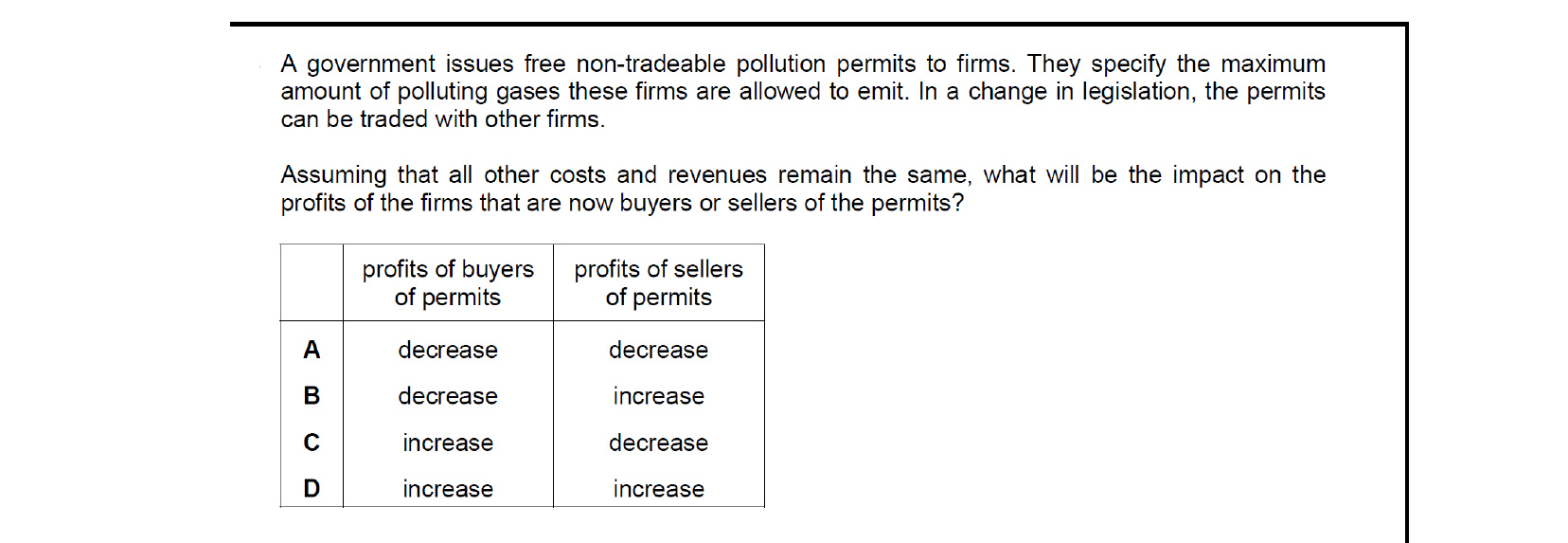
When pollution permits become tradeable, firms that need extra permits must buy them, raising their costs and so reducing their profits. Firms that can cut emissions below their allocation sell their surplus permits, generating extra revenue and raising their profits. Profits of buyers fall and profits of sellers rise — option B.
38.2Other tools to correct market failure
Other government tools tackle market failure without the kind of price-and-quantity intervention used for externalities.
Behavioural insights and 'nudge' theory
Building on the behavioural approach to decision-making (Section 31.3), 'nudge' theory influences choice by presenting options in a way that steers individuals towards more effective decisions without formal regulation. Individuals retain their freedom to choose, which makes nudging a form of paternalism — governments interfere with people's affairs in their best interests rather than overriding their will.
Nudge theory typically works through information delivered by social media, letters, emails or personal communications. Examples include letters reminding older residents of the benefits of a free inoculation and explaining how to obtain one, or a city media campaign promoting cycling and bus use rather than private car driving. Travellers can also be nudged towards a more responsible attitude to air travel by being made aware of the emissions caused by non-essential flights, with alternatives such as rail journeys or staying at home highlighted. Many governments used nudge messaging during the COVID-19 pandemic, encouraging behavioural change without resorting solely to mandates.
Nudge works, but only to a limited extent. It is best used in combination with the other policies that are already addressing the underlying market failure.
Direct provision of goods and services
Public goods cannot be efficiently provided by markets (Section 12.1) because non-rivalry and non-excludability make it impossible or socially undesirable to charge for them. Direct provision by the government is the only practical option. For merit goods such as healthcare and education, the government typically provides services free of charge or at subsidised prices, especially for low-income families, for three reasons:
- Positive externalities. Third parties benefit when an individual is treated for an infectious disease or educated; without subsidy or free provision, treatment or education may not be taken up.
- Imperfect information. Many people under-estimate the value of education or healthcare and would forgo it if they had to pay; free provision raises take-up.
- Wider economic benefits. Government provision of merit goods adds to the quality of human capital, supporting economic growth.
Nationalisation and privatisation
Nationalisation is the transfer of a private-sector business to state ownership. Market failure can arise when an industry is not run in the public interest, and externalities can be best managed if the industry is in public hands. Natural monopolies are an obvious case: duplicating a rail network or a water supply leads to inefficiency, higher prices and less provision. Effective rail networks generate external benefits that the market does not recognise — urban commuters gain better access to employment, mass transit systems ease congestion in crowded cities, and rural rail services support people in remote areas. Coal production, electricity generation and water provision generate significant negative externalities that may be better managed under state ownership. Some nationalised industries, especially rail, have cost structures that make them loss-making, so government subsidies are required to maintain service levels.
Privatisation moves a nationalised industry into the private sector. It has been widely applied since the mid-1980s, first in the UK and then in many other high-income countries, emerging economies in central and eastern Europe, and middle-income countries including China, Malaysia and Pakistan. Supporters argue that breaking up state monopolies produces a more efficient allocation of resources, that managers in the private sector are accountable to shareholders, and that costs and prices will fall under competition. Critics argue that privatisation often replaces a public monopoly with a private one — the new owner has the market power to raise prices and restrict output, and consumers do not benefit. Globally there has not been a major shift back towards nationalisation; the focus of policy has been to regulate privatised industries using the methods described in Section 38.1.
Key concept link — The role of government and the issues of equality and equity
Privatisation allows firms a greater freedom to operate in the market; government regulation is invariably necessary to ensure that consumers are not exploited and that social equity is not compromised.
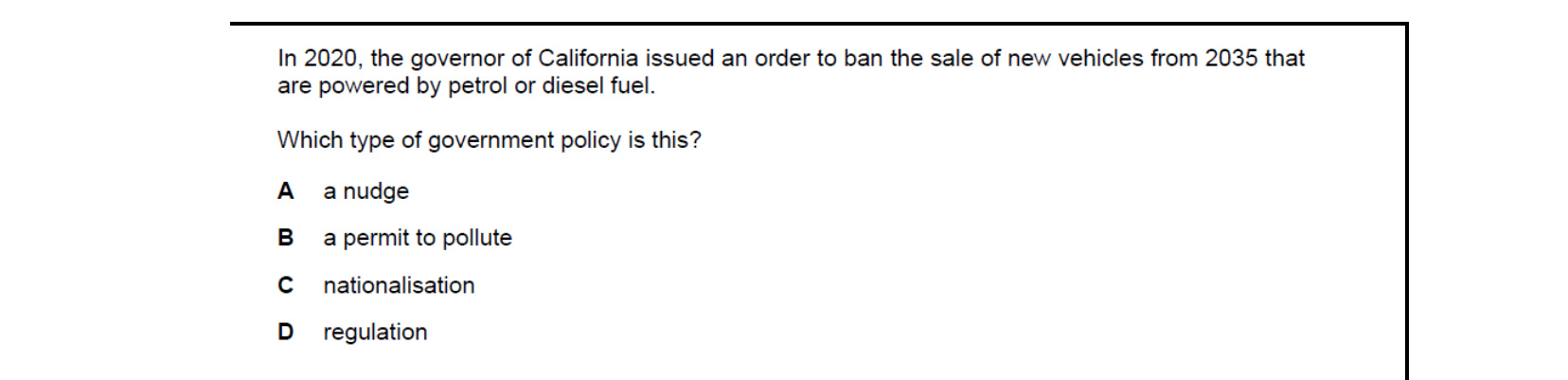
An outright ban or compulsory rule imposed by law is a form of regulation. The governor's order legally prohibits the sale of new petrol and diesel vehicles from 2035, leaving firms no choice rather than nudging them or pricing the externality. The correct type of government policy is therefore regulation (option D).

Privatisation is defined as the transfer of ownership of state-owned (public sector) assets to the private sector — for example by selling shares in formerly nationalised industries. Option D captures this directly; the other options describe takeovers, bond purchases or buying shares in already-private firms.
38.3Government failure in microeconomic intervention
In principle, government policies to correct market failure raise economic efficiency. In practice, not all policies work as planned. Government failure occurs where government intervention to correct market failure leads to a net loss of economic welfare. There are three main causes: imperfect information, unintended consequences, and policy conflict.
Imperfect information
Correct policies require correct information. If the government's information is inaccurate or incomplete, the policy may itself produce inefficiency. Typical examples include:
- Not knowing the true cost of a negative externality. The cost of air pollution is hard to estimate, and the source can be hard to trace, so the correct level of a pollution tax cannot be set with any precision. The wrong tax produces the wrong level of production and an even greater inefficiency in resource use.
- Setting road pricing charges. Many economists advocate road pricing, but there are few real-world examples to draw on, so the correct charge is uncertain. Too high or too low and resources are misallocated.
- Not knowing consumer demand for a merit good such as free healthcare, especially with no precedent to draw on. Without an accurate demand estimate, the cost of intervention cannot be properly planned, and the wrong amount of the service is produced or funded. The same problem applies to public goods.
Unintended consequences
Government intervention can produce undesirable side-effects that themselves create inefficiencies:
- Taxes distort incentives. High marginal rates of income tax can discourage extra work, so scarce resources are not used to best effect.
- Generous benefits paid to unemployed workers may discourage them from looking for work.
- Politicians often act to remain in government rather than to maximise efficiency. Road pricing, for example, has substantial potential to reduce congestion and correct market failure but is unpopular with car users, so governments may avoid introducing it from fear of losing votes.
Policy conflict
Government intervention is often justified by the wish to reduce inequality, but it can sometimes increase inequality. Any tax has a distributional impact: a tax on domestic fuel that aims to reduce greenhouse gas emissions may fall most heavily on older households, who use proportionately more fuel for heating, and the tax may then be seen as unfair. Fossil-fuel subsidies that protect manufacturing jobs and competitiveness are inconsistent with sustainable development goals. Agricultural subsidies in high-income countries raise the prices their consumers pay above the cheaper world-market price. Deregulating air transport has produced much cheaper fares and many more passengers — a personal benefit for travellers but in conflict with the need to conserve non-renewable resources and reduce emissions. In each case one government objective is being met at the expense of another.

Government failure occurs when intervention worsens resource allocation or net welfare. An increase in consumer surplus (option C) is a welfare gain, not a loss, so it is not an example of government failure. Options A, B and D — less efficient allocation, net welfare loss, and social costs exceeding social benefits — are all classic descriptions of it.
End-of-chapter practice
Past-paper questions from CIE 9708. Pick A, B, C or D. Answers are saved on this device — press Download report (PDF) at the top to save them.
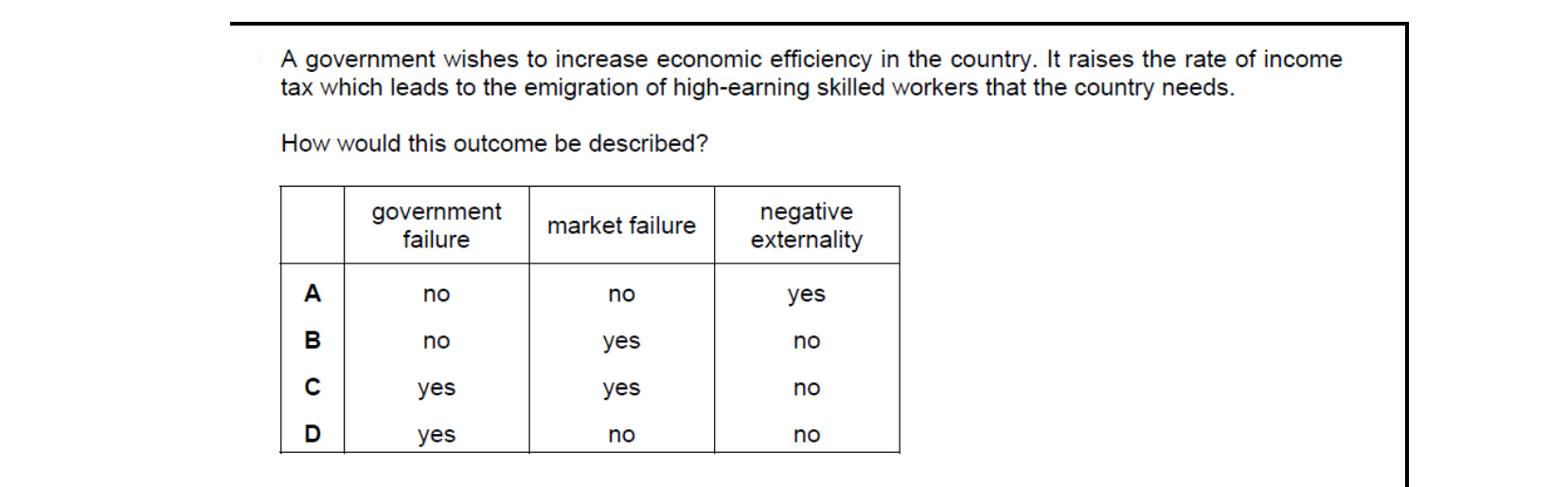
Raising income tax to improve efficiency but instead driving away skilled workers worsens, rather than improves, the allocation of resources — this is government failure. There is no market failure (the market itself was functioning) and no negative externality (the emigration is a direct response, not a third-party spillover). The combination is yes / no / no — option D.
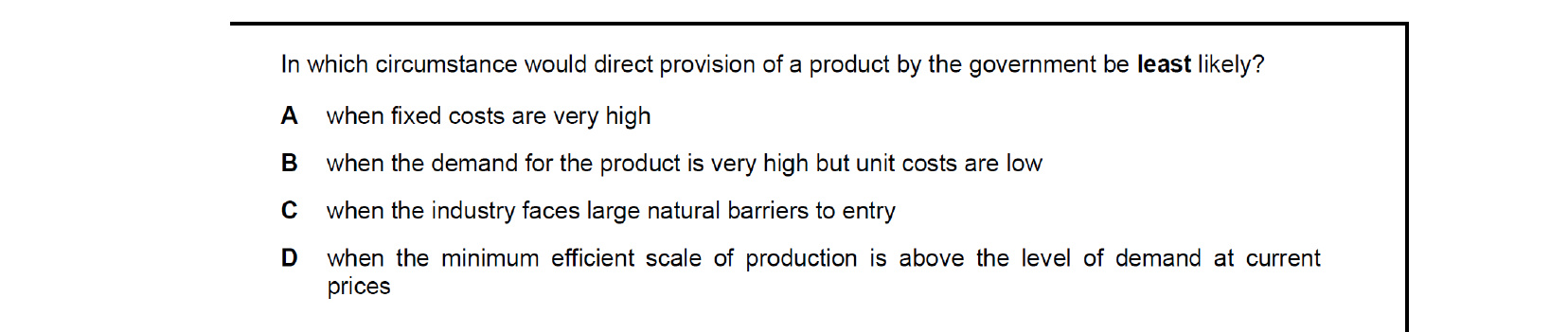
Direct government provision is reserved for cases where private firms would under-supply — high fixed costs, large natural barriers to entry, or a MES above market demand. When demand is very high and unit costs are low (option B), the private sector will happily provide the good profitably, so direct provision by the government is the least likely choice.
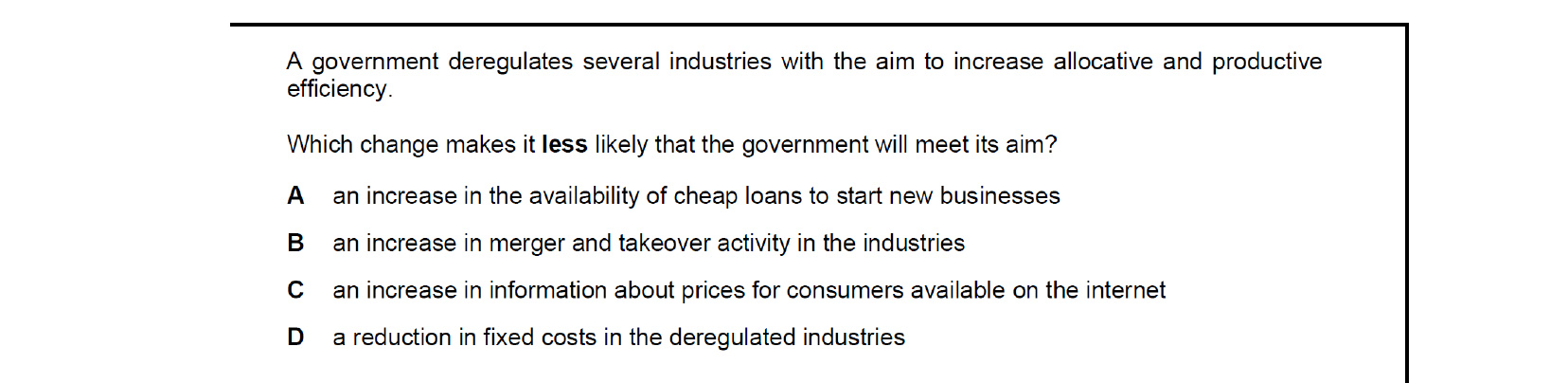
Deregulation aims to raise efficiency by intensifying competition. An increase in mergers and takeovers (option B) does the opposite — it concentrates the market, raises market power and reduces competitive pressure, undermining both allocative and productive efficiency. The other options all support more competition or lower costs.

A government nationalises a private firm where social objectives — particularly the provision of merit goods such as health or education — would not be met by a profit-maximising private operator. Public ownership lets the state supply at a price below cost or below private-sector output to address under-consumption. The correct rationale is option B.
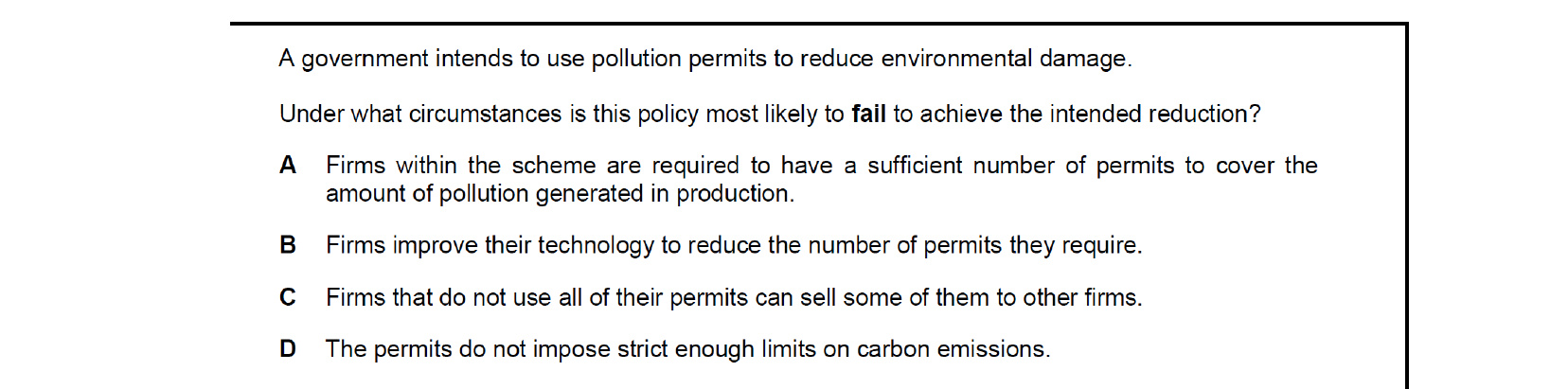
Pollution permits cut emissions only if the cap they impose is binding. If the limits set in the permits are not strict enough (option D), firms already pollute within them, so the scheme imposes no real constraint and emissions are not reduced. The other options are how a well-designed permit scheme is supposed to work.
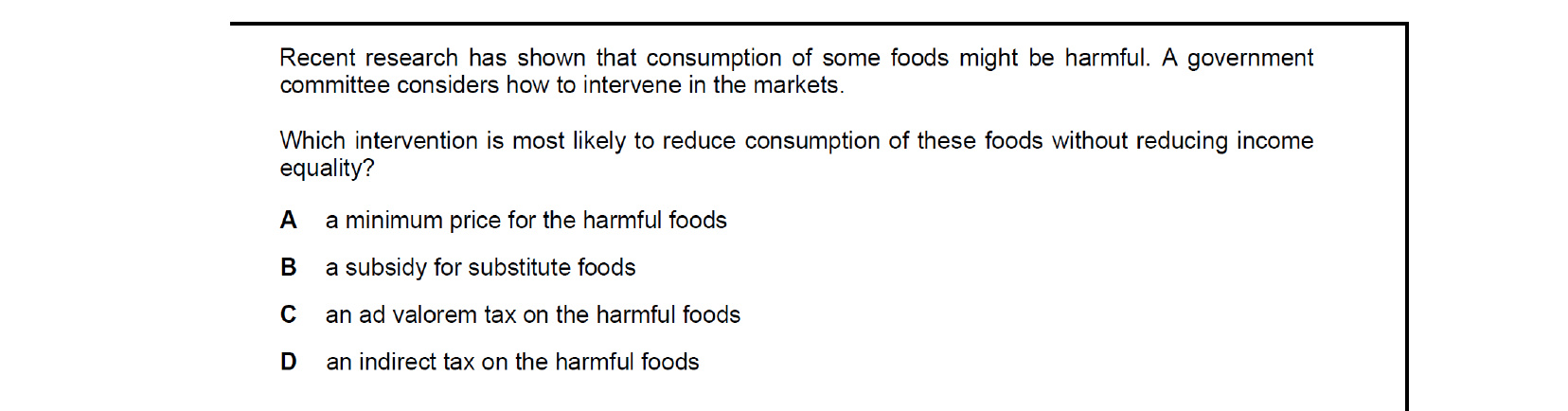
An indirect tax or minimum price on harmful foods raises their price, which falls disproportionately on low-income households and worsens income equality. A subsidy on substitute foods (option B) instead cuts the price of the healthy alternative, encouraging substitution away from the harmful good while leaving lower-income consumers better, not worse, off.
Attempt the practice questions above to build your score.
Self-evaluation checklist
After studying this chapter, you should be able to:
- Evaluate the effectiveness of government policy tools that can be used to correct market failure due to negative production externalities: specific and ad valorem indirect taxes, regulations, pollution permits, property rights.
- Evaluate the effectiveness of government policy tools that can be used to correct market failure due to negative consumption externalities: specific indirect taxes, price controls, provision of information, production quotas.
- Evaluate the effectiveness of government policy tools that may be used to correct market failure due to positive production externalities: subsidies, provision of information.
- Evaluate the effectiveness of government policy tools that may be used to correct market failure due to positive consumption externalities: direct provision, subsidies.
- Evaluate the effectiveness of other tools to correct market failure: behavioural insights and 'nudge' theory, direct provision of goods and services, nationalisation and privatisation.
- Discuss the causes and consequences of government failure: imperfect information, unintended consequences and policy conflict.
Want more practice? Drill this chapter's past-paper MCQs (144 questions) →