Chapter 37 — Differing Objectives and Policies of Firms
Cambridge International AS & A Level Economics (9708) · Unit 8.3 · 4th edition coursebook
Learning objectives
- Analyse the traditional profit-maximising objective of firms.
- Explain other objectives of firms, including survival, profit satisficing, sales maximisation and revenue maximisation.
- Analyse price discrimination, including the conditions for effective price discrimination and the consequences of price discrimination.
- Evaluate other pricing policies, including limit pricing, predatory pricing and price leadership.
- Explain the relationship between price elasticity of demand and a firm's revenue for a downward sloping demand curve and a kinked demand curve.
Key terms
- profit satisficing
- A firm's objective to make a reasonable or minimum level of profit.
- sales maximisation
- A firm's objective to maximise the volume of sales.
- cross-subsidisation
- Profits from one part of a firm are used to offset losses made elsewhere in the business.
- revenue maximisation
- A firm's objective to maximise total revenue.
37.1The traditional profit maximising objective
Economists traditionally assume that firms will seek to maximise their profits. Profit maximisation means achieving the greatest possible difference between total revenue and total cost, where total cost includes normal profit. A firm earning only the minimum level of normal profit is producing at the break-even output; no supernormal profit is being made. Most firms aim for supernormal profit as the reward for risk-taking, even if only in the short run (see Figure 37.3).
The profit-maximisation rule is to produce up to the point where the cost of making the last unit just equals the revenue from selling it - that is, where MC = MR. At lower outputs the firm is sacrificing potential profit because each extra unit adds more to revenue than to cost. At higher outputs the firm is making a loss on each successive unit, dragging total profit down. Cutting output back to where MC = MR restores the maximum.
Why firms may not in fact maximise profit
Several factors mean that real firms often do not operate at the profit-maximising output:
- The profit-maximising output is difficult to identify in practice. Many firms instead calculate average total cost and add a standard profit margin - cost-plus pricing - which is unlikely to give the maximum.
- Short-term profit maximisation may not be in the long-term interest of the firm. Firms with large market shares may want to avoid the attention of regulators such as the UK's Competition and Markets Authority or the US Department of Justice.
- Large supernormal profit attracts new entrants, particularly where barriers to entry are low.
- High profits can damage relationships with stakeholders such as consumers and workers, who may resent senior managers and shareholders earning very large returns.
- The management itself may not want to maximise profit: high profits attract takeover bids and competitive responses from rivals, both of which threaten managers' positions. This is another instance of the principal-agent problem.
Key concept link - The margin and decision-making
In a perfectly competitive market, firms will produce up to the point where the revenue generated by an extra unit of output is equal to the cost of producing it.
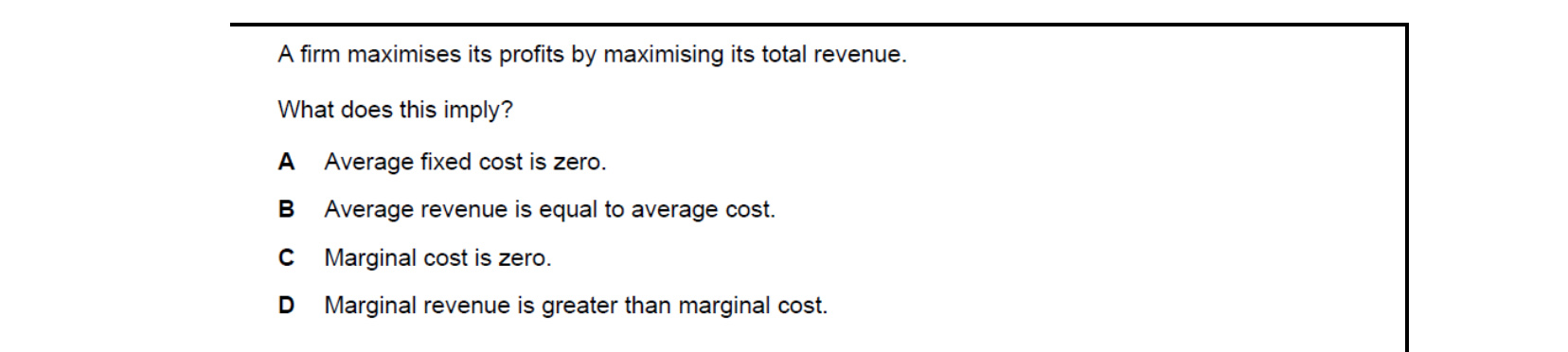
Profit is maximised where MC = MR. Total revenue is maximised where MR = 0. If a firm maximises profit by maximising revenue, the two conditions must coincide, which means marginal cost must equal zero (option C). This only occurs when producing extra units adds nothing to cost.
37.2Other objectives of firms
Dissatisfaction with the simple profit-maximisation assumption has led economists to propose other objectives - usually called managerial or behavioural objectives - based on what firms actually do.
Survival
Firms facing unexpected external threats - loss of a major customer, a severe downturn, an external shock - may adopt a short-term objective of survival. Survival means minimising losses long enough to develop a revised strategy. There are limits: if the firm is not covering its variable costs, closure is the only sensible outcome, but as long as variable costs (though not total costs) are being recouped, the firm can keep going while it tries to map out a retrieval strategy. The growth of online sales has put many high-street retailers of fashion clothes, electrical goods, books and music products into precisely this position.
Profit satisficing
Profit satisficing is the pursuit of a reasonable or minimum level of profit - sufficient to satisfy shareholders while keeping other stakeholders, especially workers and consumers, content. The firm is treated as a set of interest groups, each with its own objectives that may change over time. Workers expect pay rises and better conditions; consumers expect lower prices where rivals are pressing. The firm sacrifices some potential short-term profit to meet these expectations.
Where shareholders are divorced from control, the management's motives may centre on growth rather than profit, with managers placing weight on comfortable working conditions, status, job security and fringe benefits. If the firm has close rivals, the threat of failure makes managers more cautious. Profit satisficing also affects firms that have enjoyed high market share for a long time - complacency about costs or product/process innovation can erode profits, and in extreme cases force exit, as in the case of a firm producing music CDs faced with the switch to streaming.
Sales maximisation
Sales maximisation is the objective of maximising the volume sold, not the revenue from sales. The firm increases output up to the break-even point where total revenue just covers total cost; producing beyond this would mean loss-making. Loss-making sales maximisation is possible only when cross-subsidisation from profitable parts of the firm can cover the losses elsewhere. State-owned bus operators, for example, may use city profits to keep low-density routes running for social reasons. Sales can also be maximised when a firm pursues growth maximisation through increased market share, exploiting economies of scale via mergers and acquisitions. Deliberately cutting price to make a loss can also be a strategy to deter or eliminate entrants - predatory pricing, with the same questionable legality discussed in Section 35.2.
Revenue maximisation
Revenue maximisation is closely connected to the principal-agent problem. In large firms with separated ownership and control, senior managers' salaries and bonuses are typically tied to total revenue, which is easier to monitor than profit. Production continues until MR = 0: any further unit would reduce total revenue. A revenue maximiser therefore produces a higher output than a profit maximiser. The firm may operate where MC > MR, provided MR is still positive, since total revenue is still rising.
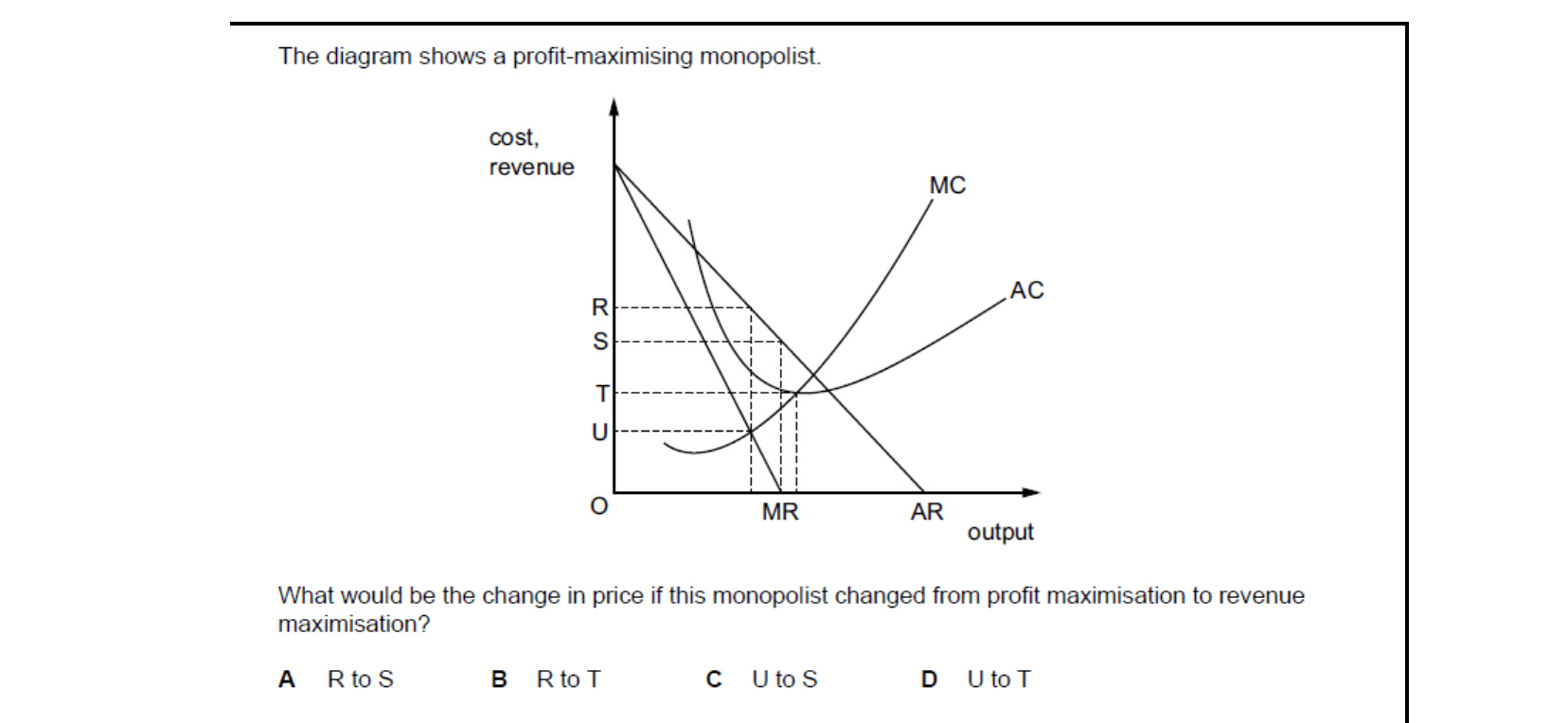
A profit-maximising monopolist sets price where MC = MR, giving the higher price R. Switching to revenue maximisation means producing where MR = 0, which lies further down the AR curve, so the price falls to S. The change in price is therefore R to S.
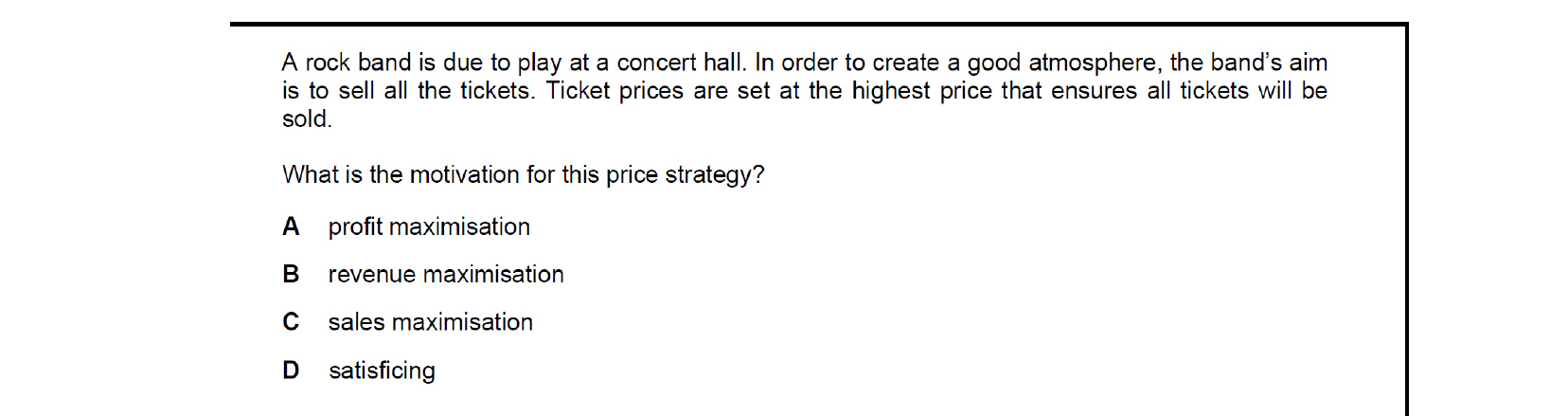
The band sets the highest price at which every ticket still clears, i.e. it deliberately picks the price that maximises units sold rather than profit or revenue. Pushing volume to the largest quantity the market will absorb is the defining objective of sales maximisation, option C.

Objectives diverge from profit maximisation when ownership and control are separated. When a firm has many shareholders but is run day-to-day by salaried managers/employees (option D), the agents pursue their own goals — sales growth, prestige, perks — rather than maximum profit for the principals.
37.3Price discrimination
Price discrimination is a pricing policy that can be used by any firm with some control over its price - that is, any firm facing a downward-sloping demand curve. The only structure in which it cannot be used is perfect competition. By splitting up the output and selling at different prices to different consumers, the firm increases its profit by reducing consumer surplus and converting it into producer surplus (see Figures 37.5 and 37.6).
Conditions for effective price discrimination
For price discrimination to work, the firm must have control over price, it must be able to separate consumers into different groups (or sell unit by unit), and it must prevent resale - consumers buying at the cheap price and reselling at the higher price would unravel the scheme. The groups must have different willingness to pay or different price elasticities of demand.
The three degrees
- First-degree price discrimination sells each unit to a different consumer at the maximum price that consumer is willing to pay. It is hard to achieve in practice. Service-sector examples include a private doctor charging according to ability to pay, a car dealer assessing what a customer might pay for a second-hand car, or an estate agent selling a property. Each transaction has a unique price and there is no immediate scope for resale. The demand curve and the marginal revenue curve coincide, so marginal revenue equals price.
- Second-degree price discrimination charges a higher price for the first units and a lower price for successive units, so consumers buy more only if the price falls. A typical example is volume discounts on food items, car tyres or season tickets. The consumer benefits and so does the firm, whose output, total revenue and profit can rise.
- Third-degree price discrimination is the most common form. The firm actively separates consumers into groups with different price elasticities of demand and charges each group a different price. Consumers with inelastic demand pay more; those with elastic demand pay less. Air fares booked earlier tend to be cheaper than fares booked closer to departure; learners may receive a discount at the cinema or a food stall. The overall effect is not entirely predictable. The firm's revenue and profits should rise - otherwise there is no point in discriminating - but some consumer groups benefit while others pay more.
Consequences
Price discrimination can allow a monopolist to operate at a profit even when a single-price firm could not cover costs. At a single profit-maximising price the firm might make a loss; by selling units separately at the maximum each consumer is willing to pay, total revenue rises enough to turn the loss into a supernormal profit. In effect, the monopolist captures the consumer surplus and converts it into producer surplus. As long as consumers are willing to pay the higher prices, there is no consumer exploitation.
Price discrimination has mixed welfare effects. It can improve allocative efficiency by extending output, but it achieves this by converting consumer surplus into producer profit. From an equity standpoint this disadvantages consumers, especially those whose inelastic demand allows the firm to charge them more.
Key concept link - The role of government and the issues of equality and equity
Price discrimination favours producers at the expense of consumers. Government regulation is often necessary to avoid consumers being exploited.

Third-degree price discrimination charges different prices to different consumer groups. For it to be effective, the firm must be able to separate customers into distinct sub-markets (often by age, location or time of purchase) and prevent resale between them, so option B — customers must be divided into separate markets for the same product — is the necessary condition.
37.4Other pricing policies
Beyond price discrimination, other types of pricing policy may be used within specific market structures. The most important examples are limit pricing, predatory pricing and price leadership, all of which are most relevant to monopoly and oligopoly.
Limit pricing
Limit pricing is a pricing policy that is applied in monopolies and oligopolies. It involves firms setting a lower short-run price to deter new firms from entering their market. This market may even be contestable. The new firms might have been attracted by the supernormal profits that were being earned. At this new price, the established firm no longer maximises profits, but this is only to be expected for a short period of time. The lower price effectively acts as a barrier to entry.
To work, a monopolist or oligopolist needs to increase output (or the services provided) to such a level that a new firm is not in a position to make a profit. An example might be in an unregulated taxi market where an established firm reduces rates and at the same time increases the number of its vehicles, making it impossible for a new entrant to make an impact. The likelihood is that these tactics will deter the new firm from trying to enter the market.
Predatory pricing
Predatory pricing occurs when a firm feels threatened by a new firm entering a market. The established firm responds by setting a price that is so low that the new firm has no alternative but to match it. The new firm cannot make a profit; in time, it will be forced out of the market. When this happens, the established firm will put its prices back to their former level.
Predatory pricing can also be applied by two established firms in a market. If one firm believes its rival is gaining market share, it can cut prices to protect its own market share. If these cuts are deep enough and sustained over time, the rival firm may be forced to leave the market.
The distinction between limit pricing and predatory pricing is one of intent and target: limit pricing is aimed at deterring entry by potential rivals, while predatory pricing is aimed at driving out an entrant that has already arrived or a competitor that is already in the market.
Price leadership
Price leadership is a common feature of oligopolistic markets. All firms in the market accept the price that is set by the leading firm, which is often the firm with the largest market share or the brand leader. They then alter their own prices in line with those of the leader. It is seen as a way of avoiding price competition yet maximising total profits for all firms, while allowing various forms of non-price competition to prevail. Familiar examples are found in petroleum retailing, where the market leader is typically a well-known multinational, and in certain markets for branded retail goods or fast food.
When the leading firm announces a price increase, all others quickly follow, sometimes in just a matter of hours. It is the same when a price fall is announced; smaller rivals are forced to follow the fall in price to retain market share. However, the downside for the smaller rivals is that since their costs are higher, matching a price decrease could result in sustained losses and the eventual exit of these rivals from the market.
A simple representation of price leadership assumes there are two firms in the market, A and B, sharing the same demand curve D. Firm A is the lower-cost producer and the price leader. It maximises its profits at the output where MC = MR, producing output QA and selling at price PA. Firm B's ideal price, given its own higher costs, would be at the higher level PB, but if it fixes its price there it will not be able to compete with A's lower price. Firm B is therefore compelled to lower its price to PA, earning lower profits than it otherwise would because of its higher costs of production.
Price leadership can also be explained by the kinked demand curve model (see Section 35.3). The firm that takes the first step to alter price is the price leader, and the response of rivals - following the leader down on a price cut but not following the leader up on a price rise - generates the asymmetric reactions captured by the kink. Price leadership does not have to involve any formal cooperation between firms: it can arise simply from the recognition that following the dominant firm's price is safer than trying to compete head-on.
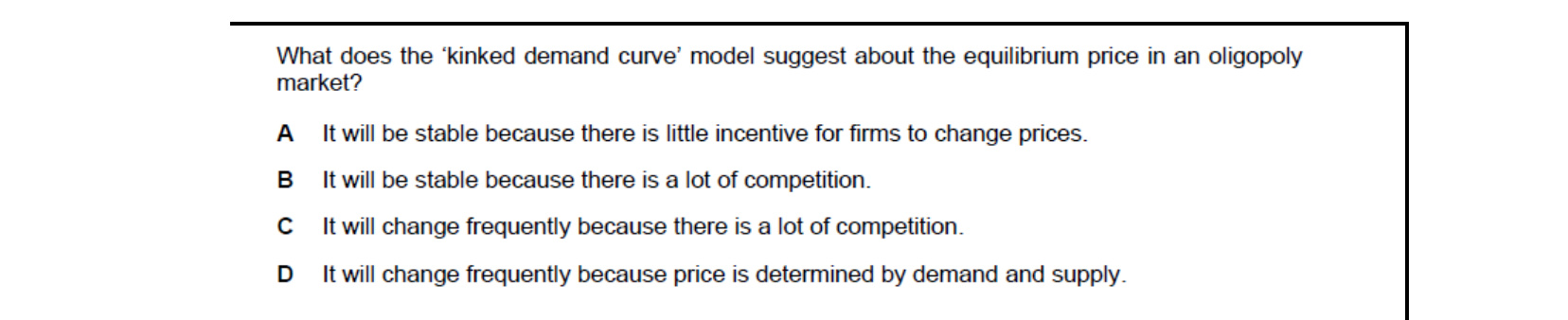
The kinked demand curve assumes rivals match price cuts but ignore price rises. Demand is therefore elastic above the kink and inelastic below it, so a firm loses revenue whichever way it moves price. Equilibrium price is stable because individual firms have little incentive to change it (option A).
37.5Relationship between price elasticity of demand and a firm's revenue
When a firm changes its price, the price elasticity of demand for its product determines what happens to output and total revenue. The success of the price change depends on whether demand is elastic or inelastic (see Figure 37.7).
Downward-sloping demand curve
For a firm facing a straight-line, downward-sloping demand curve, price elasticity varies along the curve. As the price falls from its highest value, sales initially rise more than proportionally, giving PED a value greater than 1 - demand is elastic - and total revenue rises. As price continues to fall, PED reaches unity at the output where total revenue is maximised; here marginal revenue is zero. Below this output, PED falls below 1 - demand is inelastic - and further price cuts reduce total revenue, so marginal revenue becomes negative.
The link between PED and marginal revenue is therefore: on the elastic portion of the demand curve, MR is positive and total revenue is rising with output; where PED = 1, MR is zero and total revenue is at its maximum; on the inelastic portion, MR is negative and total revenue falls as output rises.
For the firm, the practical implication is clear. A firm operating on the elastic portion should lower price to boost total revenue; a firm on the inelastic portion should raise price. Revenue is maximised where MR = 0. A firm may also accept a lower price and produce above the profit-maximising output in order to raise market share in a growing market - a penetration pricing policy. A revenue-maximising firm pushes output beyond MC = MR until MR has fallen to zero. There may still be supernormal profit if total revenue still exceeds total cost, but this is not guaranteed.
Kinked demand curve
In the kinked demand curve model of oligopoly (Section 35.3), the relationship between price elasticity and revenue is different. Above the kink, demand is relatively elastic: if the firm raises price, rivals do not follow, sales fall sharply and total revenue falls. Below the kink, demand is relatively inelastic: if the firm cuts price, rivals follow, the firm's extra sales are small and total revenue still falls. The rational strategy is to leave price at the kink, where revenue is maximised at P x Q. Firms can remain at this point for considerable lengths of time.
End-of-chapter practice
Past-paper questions from CIE 9708. Pick A, B, C or D. Answers are saved on this device — press Download report (PDF) at the top to save them.
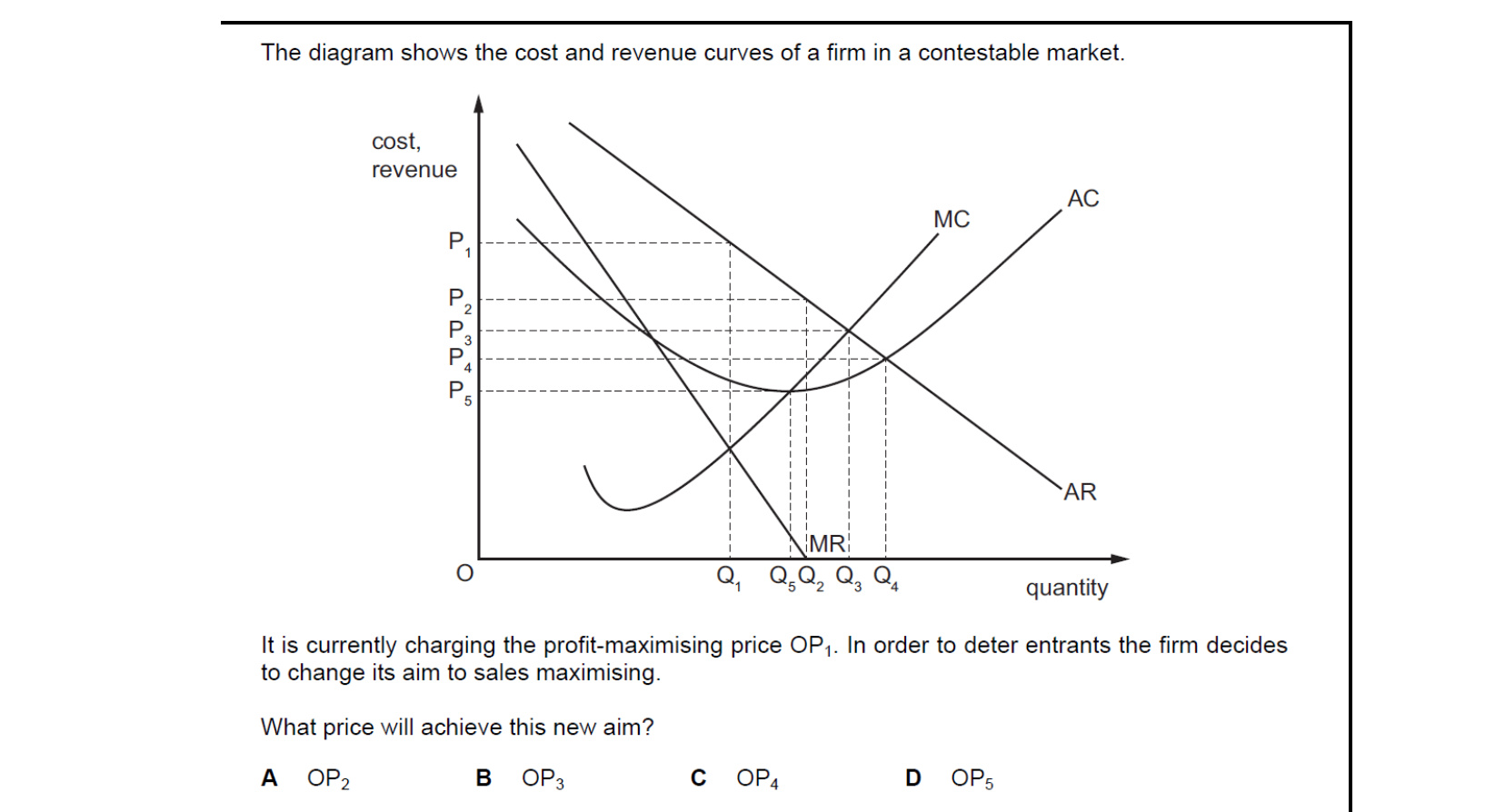
Sales maximisation means producing the largest output at which the firm still earns at least normal profit, i.e. where AR = AC. On the diagram this is the lower price OP4 — output is pushed past the profit-maximising point until total revenue just covers total cost, deterring entrants who could not survive at that price.
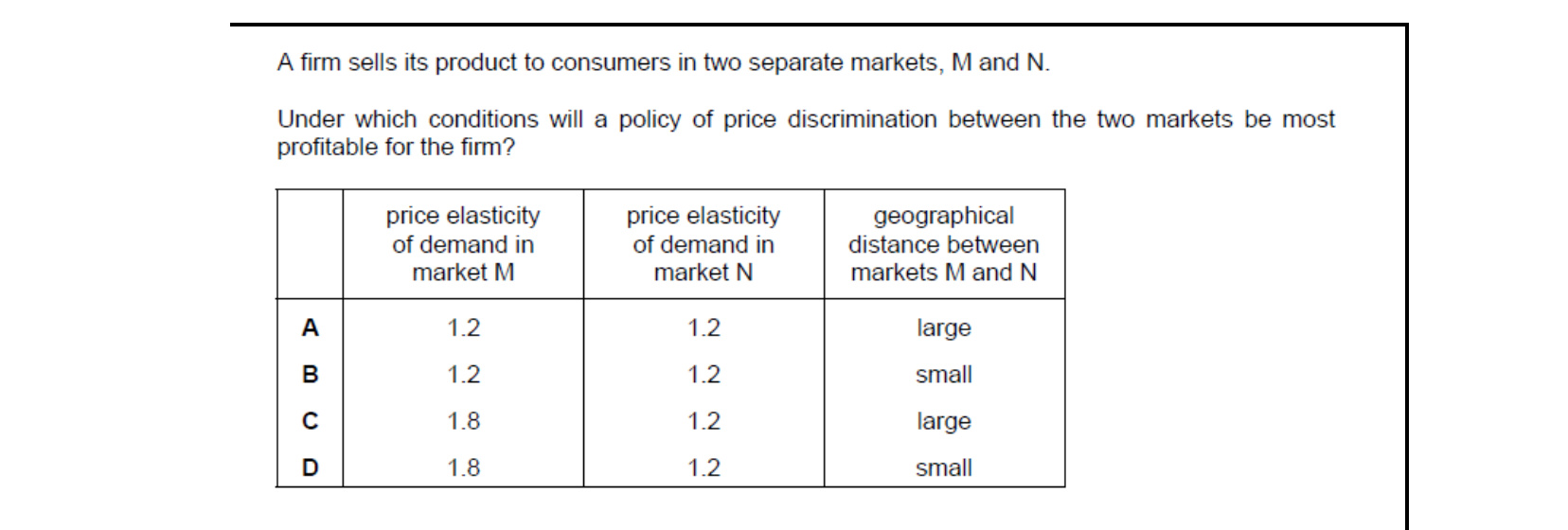
Price discrimination is most profitable when (i) the price elasticities of demand in the two markets differ significantly, so different prices can be charged, and (ii) the markets are far apart, so consumers cannot arbitrage by buying in the cheap market and reselling in the dear one. Option C — PEDs of 1.8 and 1.2 with a large geographical distance — best satisfies both conditions.
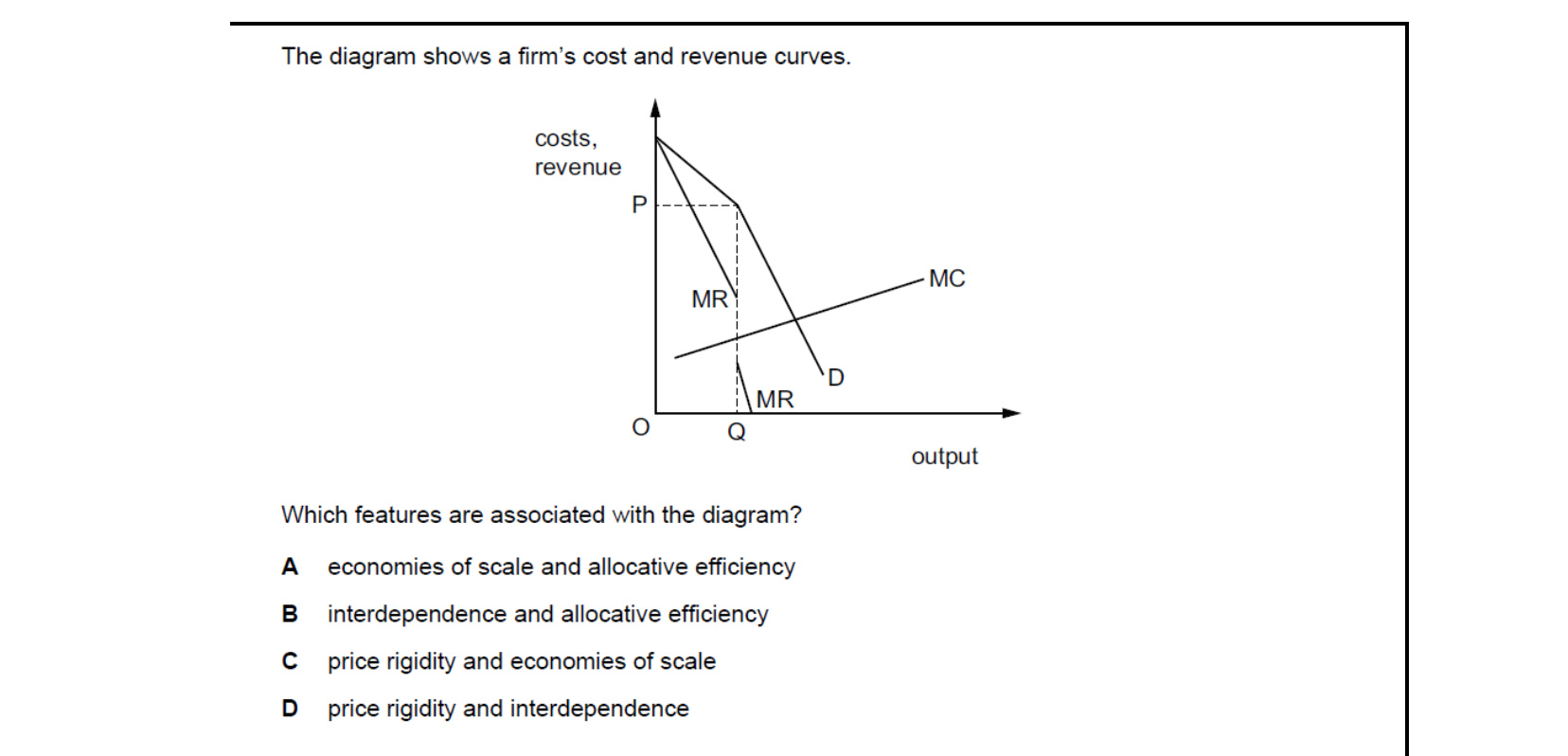
The diagram shows a kinked demand curve with a discontinuous MR — the standard oligopoly model. Its two characteristic features are price rigidity (the kink discourages price changes) and interdependence between firms (each firm's optimal price depends on rivals' expected reactions), so the answer is D.

The kinked demand model is built on the individual firm's expectation that rivals will match a price cut but not a price rise. This asymmetric reaction creates the kink and the discontinuity in MR, producing price rigidity. The explanation is option C — expectations about other firms' responses to its price changes.
Attempt the practice questions above to build your score.
Self-evaluation checklist
After studying this chapter, you should be able to:
- Explain why profit-maximising is the traditional objective of a firm.
- Explain how firms may have other behavioural objectives such as survival, profit satisficing, sales maximisation and revenue maximisation.
- Consider how price discrimination is used by monopolists to increase profits.
- Analyse the conditions for effective price discrimination (first degree, second degree, third degree) and the consequences of price discrimination.
- Evaluate other pricing policies: limit pricing, predatory pricing, price leadership.
- Explain the relationship between price elasticity of demand and a firm's revenue: downward sloping demand curve and the kinked demand curve model.
Want more practice? Drill this chapter's past-paper MCQs (87 questions) →