Chapter 36 — Growth and Survival of Firms
Cambridge International AS & A Level Economics (9708) · Unit 8.2 · 4th edition coursebook
Learning objectives
- Explain reasons for the different sizes of firms.
- Explain the difference between internal and external growth of firms.
- Analyse the methods, reasons and consequences of integration (horizontal, vertical, conglomerate).
- Analyse the conditions and consequences for an effective cartel.
- Discuss the principal-agent problem.
Key terms
- conglomerate
- A company with a large number of diversified businesses.
- economies of scope
- Where a reduction in average total cost is made possible by a firm changing the different goods it produces.
- diversification
- Where a firm grows through the production or sale of a wide range of different products.
- horizontal integration
- Where a firm merges or acquires another in the same line of business.
- vertical integration
- Where a firm grows by producing backwards or forwards in its supply chain.
- principal-agent problem
- Where one person (the agent) makes decisions on behalf of another person (the principal).
36.1Reasons for different sizes of firms
Most economies are dominated numerically by small firms. The great majority employ fewer than ten people, and the share is usually even higher in low and middle-income countries. Small firms cluster in services, retail, food production, and personal and business services, and a growing number of small knowledge- and research-intensive firms supply larger manufacturers. The persistence of small firms alongside very large multinational companies has several explanations:
- The market for some goods and services is simply too small to support large firms.
- Production may rely on specialist skills possessed by very few people.
- Service activities — lawyers, accountants, hairdressers, dentists, small shops — work best at small scale because customers want personal attention and are willing to pay a higher price for it.
- Some small firms are simply the big firms of tomorrow; only a small percentage will actually grow to that scale, but the option exists.
- Small firms face particular obstacles to growth, the most common being lack of access to borrowed capital because banks perceive them as risky.
- The owner-entrepreneur may not want the firm to grow: extra profit is not the only objective and growth can mean losing control of day-to-day running.
- Recessions and rising unemployment can trigger more start-ups as displaced employees try self-employment.
- Government enterprise schemes often provide financial help to small businesses because they create jobs and support local growth.
- Cheap access to technology through the internet and electronic devices has made small businesses more efficient and better able to compete with larger ones.
Why large firms grow
For large firms, growth is closely linked to the pursuit of profit. The main motives are:
- Cost reduction through economies of scale. Larger output spreads fixed costs and allows bulk purchasing, joint distribution and shared marketing, lowering long-run average costs. This has often driven mergers and acquisitions in food processing, vehicle production, hotels and airlines.
- Bigger market share. A higher share boosts sales revenue and profits — the so-called monopoly motive — and can also be defensive, maintaining position in anticipation of rivals' moves. In global markets, size is often necessary to compete with established multinationals.
- Diversification to spread risk. A multi-product firm has revenue streams from several activities, so a downturn in one is cushioned by the others. Sometimes existing production facilities can be reused to produce related goods — this gives economies of scope, a fall in average total cost when the range of products changes (as opposed to economies of scale, which arise when the scale of production changes).
- Capturing the resources of another business. If another firm's resources are under-utilised, its true value may exceed its accounting valuation. A takeover may restore profitability, or the firm may be broken up so that the sum of the parts sold separately exceeds the original valuation — 'asset stripping' — with the cash channelled back into the core business.

Small local bread producers compete on freshness and quality at a higher price than mass producers. If consumer preferences switch towards cheaper mass-produced bread, the small producers lose their core customer base. Television advertising, internal diseconomies of scale or congested roads have much smaller effects, so a switch in consumer preferences is the main threat to survival.
36.2Internal and external growth of firms
Firms can grow in two main ways. Internal growth happens when a firm retains some profit rather than paying it out to owners and invests it back into the business to increase productive capacity. This is most likely in capital-intensive activities where the market is expanding, and is influenced by the stage of the business cycle: most investment occurs as the economy approaches a boom. External growth involves combining with other businesses through takeovers or mergers. A takeover means buying enough shares (51% or more) to gain control of another firm; a merger has the same final result but implies an agreed combination rather than a struggle. Mergers tend to be more common during downturns or in shrinking markets where firms are left with surplus capacity.
Both routes can occur at the same time. External growth is often a quicker and cheaper way to expand than internal growth, especially where fixed costs are high — for example, it may be cheaper for one oil company to buy the assets of another than to expand its own operations, and the risks may be lower.
Diversification is a related route in which a firm produces or sells a wide range of different products. The motives are to spread risk and to exploit new market opportunities. Large diversified groups are conglomerates: each subsidiary is independent with its own board of directors, but the group spans many unrelated industries.
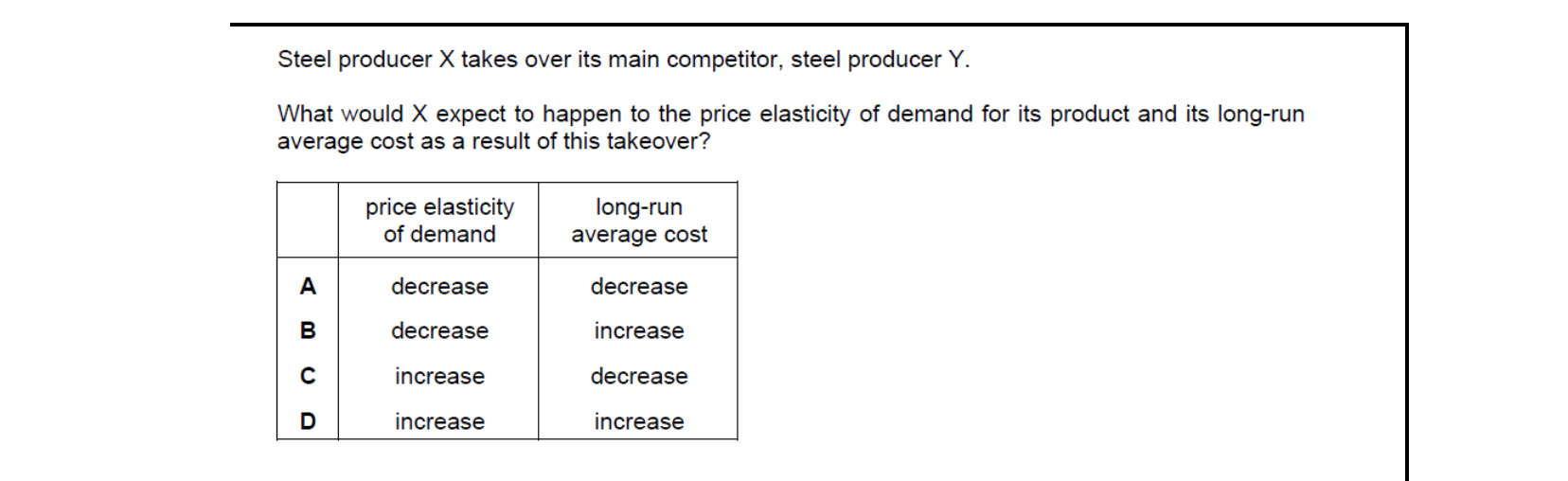
Taking over a main competitor gives steel producer X a larger market share, fewer substitutes for buyers and so less elastic demand - price elasticity of demand decreases. The merged firm also gains technical and managerial economies of scale, lowering long-run average cost. The correct pairing is therefore a decrease in price elasticity of demand and a decrease in long-run average cost.
36.3Integration
Integration is a term widely used in economics. In this context, it refers to the ways in which the individual parts of a firm have come together. This could be through:
- a merger, whereby two firms agree to join up with each other; or
- an acquisition or purchase, whereby one firm takes over control of another.
Three methods of integration can be identified: horizontal integration, vertical integration (which has both backward and forward forms) and conglomerate growth (sometimes shown alongside as 'lateral integration' when the new business is in an only loosely related area). The routes can be pictured as a chain running from raw material or component suppliers (upstream), through manufacturing in the middle, to retail outlets (downstream). Backward vertical integration moves a firm up the chain towards suppliers; forward vertical integration moves it down the chain towards retail; horizontal integration combines firms at the same stage of the chain; and conglomerate/lateral integration adds activities outside the chain altogether.
Horizontal integration
Horizontal integration is a process or strategy used by firms to strengthen their position in an industry. It involves the merger or acquisition of a business that is in the same sector of an industry. In such cases, the outcome is one of expansion. The prime motive is to reap the benefits of economies of scale: research and development costs can be pooled, production plants can be rationalised, marketing costs reduced and so on. Horizontal integration can also lead to access to new markets, increased market power and, by reducing competition, the opportunity to make supernormal profits. The danger is that this sort of growth may sometimes be blocked by governments concerned about possible monopoly abuse.
Vertical integration
Vertical integration is different. This is where a firm grows by moving into a forward or backward stage of its production process or supply chain. Forward vertical integration is where a manufacturer moves into retail. Backward vertical integration is where a manufacturer takes control over some of its supplies. Vertically integrated firms may operate across design, manufacturing, software and retail, or own the production of raw materials as well as their processing and distribution. The benefits of vertical integration include improved security and quality of supplies and reduced supply-chain costs. There are, however, disadvantages, such as higher costs if the newly acquired businesses are not effectively integrated. This can be a major problem with any merged operation. To avoid confusion, it helps to think about the two types of integration in terms of the meaning of horizontal (across) and vertical (up and down).
Conglomerate integration
The external growth of a conglomerate differs from the two forms of integration above in that growth comes from the purchase of unrelated businesses. The rationale is to spread risk. Each of the companies in a conglomerate is independent with its own board of directors. Many conglomerates are multinational companies. One benefit of a conglomerate is that losses from poorly performing subsidiaries can be offset by profits from elsewhere in the group. If losses persist then the subsidiary can always be sold. A criticism is that the diversity of a conglomerate means that the group can be difficult to manage strategically.
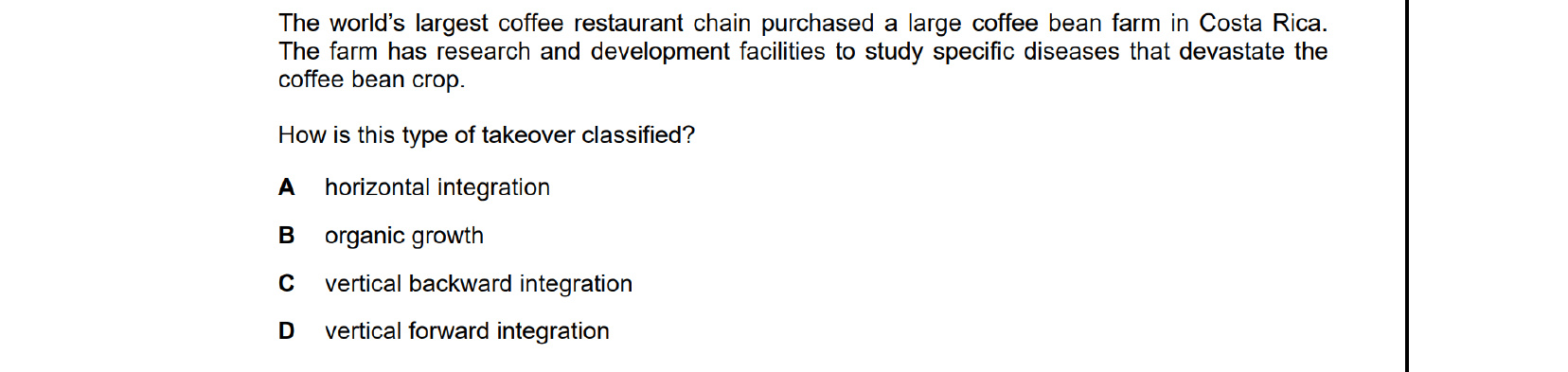
A coffee restaurant chain buying a coffee bean farm acquires an earlier stage of the supply chain - the supply of its main raw material. Moving upstream towards inputs is backward vertical integration. It is not organic (it is a takeover), nor horizontal (different stage), nor forward (would be acquiring outlets), so it is vertical backward integration.
36.4Cartels
As introduced in Section 35.3, a cartel is a formal agreement between firms in an industry to limit competition. The agreement may involve fixing the quantity to be produced by each cartel member or by fixing the price at which the product is sold. Other restrictions may also be applied. A cartel acting in unison maximises profits in the same way as a monopolist - it restricts output and raises price so that the combined profit of its members is at its greatest.
OPEC as an example of a cartel
The Organization of the Petroleum Exporting Countries (OPEC) is the best-known and longest-standing example of a cartel. Membership is open to any country that is a substantial net exporter of crude petroleum, and the organisation has expanded its market power by seeking to control prices in cooperation with other large exporting countries outside the original group. OPEC and its wider grouping account for a large share of the world's oil output and an even larger share of known crude oil reserves, plus substantial reserves of natural gas. This means the group clearly has considerable power in the market to determine not only current prices but, significantly, future prices.
OPEC's market power, while still substantial, is far less than it was at its peak when it had a near-monopoly hold over the global supply of oil. A few large exporters remain the most powerful voices within the organisation. The power of the cartel has decreased as other producing economies have obtained oil from unconventional sources such as shale and from offshore drilling. As the world's biggest oil-producing economies increase their volumes from these sources, OPEC's leverage is offset. Its economic power will weaken further if new suppliers emerge from outside the cartel, or if consumers take action that reduces consumption - for example, technology providing alternatives to oil such as electric vehicles and other innovations in transport. OPEC has denied that it acts as a single monopoly cutting output in order to charge high prices, and has pointed out that consuming-country governments often earn more from taxes on oil than producing countries do from selling it.
At the retailing end of the industry, supply is in the hands of an oligopoly of oil companies which deny that they are charging too much, insisting that profit margins are low because of fierce competition; total profits are high only because of the large turnover. Some analysts predict that there will be further horizontal integration between oil companies that are already vertically integrated. The oil industry will continue to be dominated by a few big players, mainly because of the high fixed costs and risks associated with exploration and drilling. If controversial attempts to find oil in environmentally sensitive areas are successful, OPEC's power could diminish further.
Conditions for an effective cartel
The long-term survival of a cartel depends upon high barriers to entry - without them, supernormal profits would attract new producers and the cartel would lose control of supply. Beyond barriers to entry, several conditions support an effective cartel: members must keep to the agreed quotas or prices in full; a dominant member with the power to bring others into line is useful; members ideally have similar costs, so the agreed price gives all of them an acceptable profit margin; and the cartel must not face legal prohibition.
Threats to a cartel
Several factors threaten a cartel:
- the possibility of a price war, whereby one firm breaks ranks to capture a bigger market share;
- if some members have higher costs than others, the agreed fixed price yields them fewer profits, increasing the temptation to defect;
- if there is no dominant member with the power to discipline others, the agreement weakens;
- legal obstacles - in many jurisdictions, cartels are illegal because they restrict competition and do not act in consumers' best interests.
The Prisoner's Dilemma also applies to a cartel: each member has an individual incentive to break ranks and produce above its quota even though all members are worse off if all do so. Disagreement over the target price or the production quotas allocated to each member is another recurring source of weakness. Time is part of the story: cartels that once held enormous market power can find that the economic conditions which gave them that power have changed, and even long-established examples have collapsed. Cartels set up in agricultural markets, for example, have historically broken down. It is a matter of debate how long any particular cartel can survive.

Cartels are easier to enforce when demand is predictable, so members know what each should produce and that the agreed price will hold. Greater competition from related industries, more cartel members, or a wider product range all make coordination harder. An increase in the stability of the market for its products makes cartel operation easier - the correct option.
36.5The principal-agent problem
Decisions about growth presuppose that whoever takes them has the authority to do so. In small firms this is usually the owner or partners, who agree how growth will or will not happen. In larger firms with many shareholders, ownership and management are separated, and a gap can open between the decision-makers and the owners. This is the principal-agent problem: one person (the agent) makes decisions on behalf of another (the principal).
The agent is involved day to day and so has more information than the principal - an example of asymmetric information and moral hazard. The principal does not know exactly how the agent will act and cannot be sure the agent will act in the principal's interests. In decisions about growth, the agent may pursue strategies that suit their own career and prestige rather than maximising shareholder returns. The principal is not fully aware of what the chosen growth plans involve; the resulting loss to the principal is the agency cost.
The principal-agent problem is therefore a form of market failure rooted in information failure. Principals should be best placed to determine a firm's future growth, but they often are not, and this leads to a misallocation of resources.

The principal-agent problem arises when the principals (owners/shareholders) delegate decisions to agents (managers) who may pursue their own objectives rather than the principals'. The essential feature is therefore the separation of ownership and control - profit maximisation, inter-firm cooperation and rivals' pricing are not part of the principal-agent issue.
End-of-chapter practice
Past-paper questions from CIE 9708. Pick A, B, C or D. Answers are saved on this device — press Download report (PDF) at the top to save them.

Diversification means moving into different markets so that risks across the portfolio offset one another. Economies of scale come from expanding within the same activity, not from diversifying; common pricing requires collusion; and labour productivity depends on training and methods. The defining motive for diversification is greater ability to spread investment risks across markets.
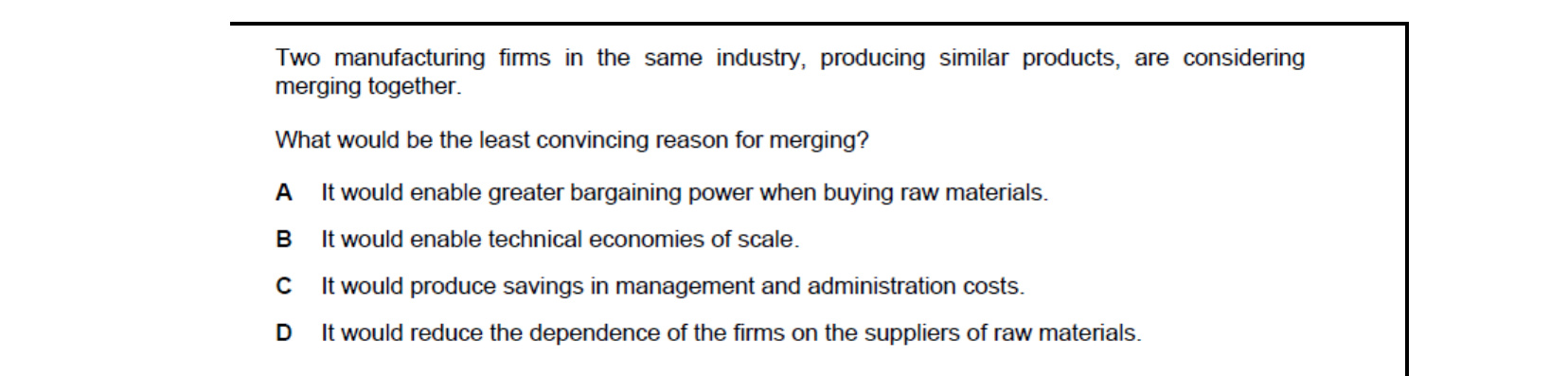
Two firms producing similar products in the same industry are merging horizontally. Horizontal mergers raise bargaining power with suppliers, achieve technical economies of scale and cut duplicated management and administration costs - all convincing motives. They do not reduce dependence on raw-material suppliers (that requires backward vertical integration), so reducing supplier dependence is the least convincing reason.
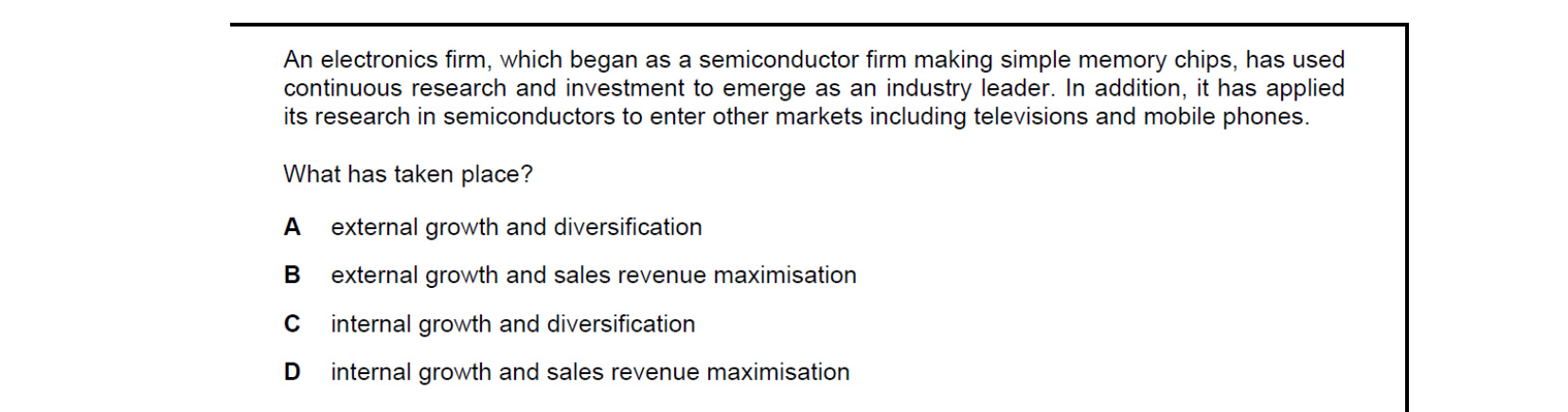
The firm has grown by reinvesting research and profits (internal growth, not takeovers) and has applied its semiconductor know-how to enter unrelated markets such as televisions and mobile phones (diversification). The correct combination is therefore internal growth and diversification.

A cartel raises group profit by restricting output, but each member is tempted to cheat by producing more. The cartel only works if production quotas are strictly enforced so no member can free-ride on the others. A large number of firms, differentiated products or low barriers to entry all undermine a cartel, so strictly enforced production quotas is the necessary condition.
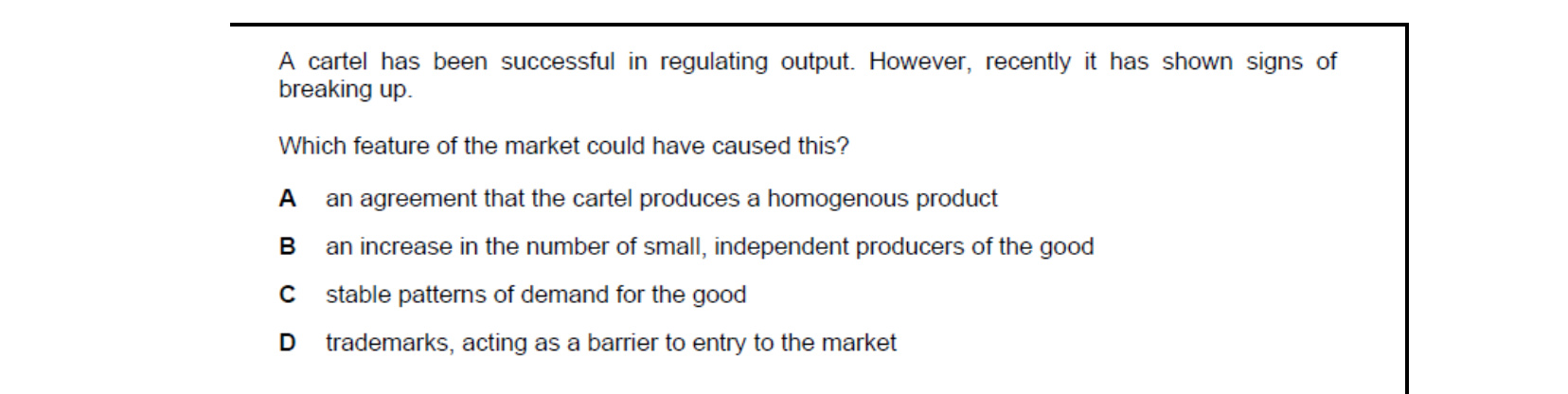
Cartels break down when new producers outside the cartel undercut the agreed price or when existing members cheat. An increase in the number of small, independent producers of the good means more output is supplied outside the cartel's control, driving the price below the cartel level and undermining the agreement.
Attempt the practice questions above to build your score.
Self-evaluation checklist
After studying this chapter, you should be able to:
- Explain the reasons for different sizes of firms.
- Understand that firms may grow internally or externally.
- Analyse the methods, reasons and consequences of integration for firms: horizontal, vertical, conglomerate.
- Explain the purpose and consequences of cartels.
- Discuss the principal-agent problem and the impact this may have on the firm.
Want more practice? Drill this chapter's past-paper MCQs (85 questions) →