Chapter 29 — Policies to Correct Imbalances in the Current Account of the Balance of Payments
Cambridge International AS & A Level Economics (9708) · Unit 6.5 · 4th edition coursebook
Learning objectives
- Understand that governments usually aim to ensure export revenue equals import expenditure in the long run; in the short run a current account surplus may benefit an economy.
- Explain how fiscal policy tools may be used to reduce a current account deficit on the balance of payments.
- Explain how monetary policy tools may be used to reduce a current account surplus.
- Explain how supply-side policy tools may be used to reduce a current account deficit.
- Explain how protectionist policy tools may be used to reduce a current account deficit.
Key terms
29.1Government policy objective of stability of the current account
Most governments aim for balance of payments stability — broadly, for the money flowing into the country from the rest of the world to equal the money flowing out. If export revenue equals import expenditure over the long run, the country does not need to take on international debt, and it is not foregoing imports it could afford to buy.
In the short run, however, a government may be content to run a current account deficit if the cause is increased imports of raw materials and capital goods that will support higher production in future, or if it allows residents to consume more goods and services than the country is currently producing. A government may also welcome a temporary surplus of export revenue over import expenditure if the country needs to boost aggregate demand or to generate the funds needed to repay external debt.
When assessing how serious an imbalance is, it is more informative to express the deficit or surplus as a percentage of GDP than to look only at the monetary amount. A small monetary deficit may represent a large share of a small economy's output, and conversely.
29.2The effect of fiscal policy on the current account
A government facing a current account deficit may use contractionary fiscal policy to reduce demand for goods and services, including imports. The main tools are an increase in income tax and a cut in government spending.
Higher income tax reduces households' disposable income, leaving them with less to spend on imports and on products produced by domestic firms. Lower government spending directly reduces demand for goods and services. As domestic demand softens, domestic firms have an incentive to find foreign markets for output that would otherwise have gone to home customers, supporting exports.
To reduce a current account surplus, a government can use expansionary fiscal policy instead — lowering income tax and raising government spending on, for example, state pensions. Consumer expenditure rises, more imports are bought, and some output that would have been exported is diverted to the home market.
Fiscal policy can shift the current account position in the short term but is unlikely to deliver a long-term solution. Once the measures are reversed, households and firms tend to return to their previous import behaviour relative to export revenue. Raising taxes also has adverse side effects: lower demand may raise unemployment and slow economic growth, and higher taxation can create disincentive effects that reduce aggregate supply.
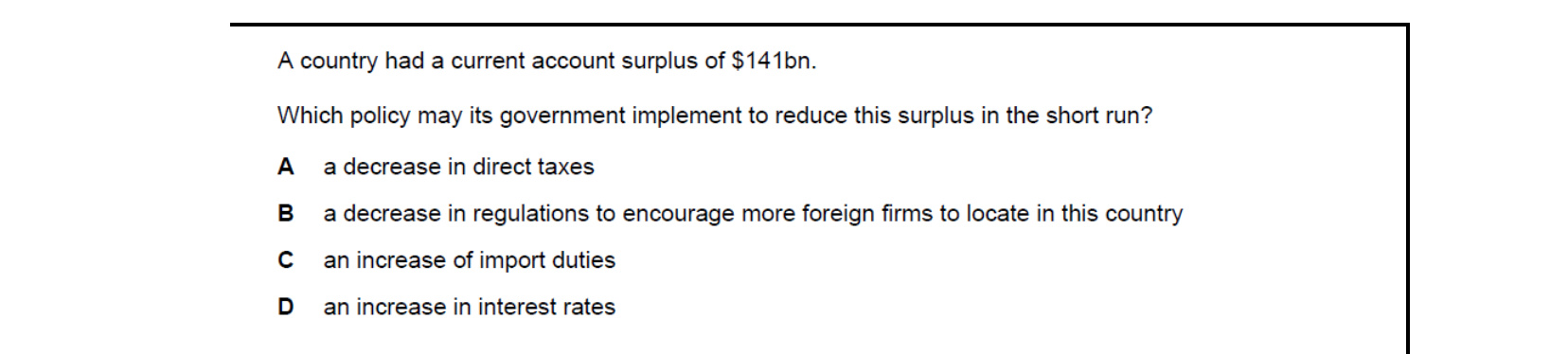
To reduce a current account surplus the government needs to boost imports or curb exports in the short run. Cutting direct taxes raises households' disposable income, which increases consumer spending — including spending on imports — and lifts domestic costs, weakening export competitiveness. The other options either restrict imports further or worsen the surplus, so a decrease in direct taxes is the correct policy.
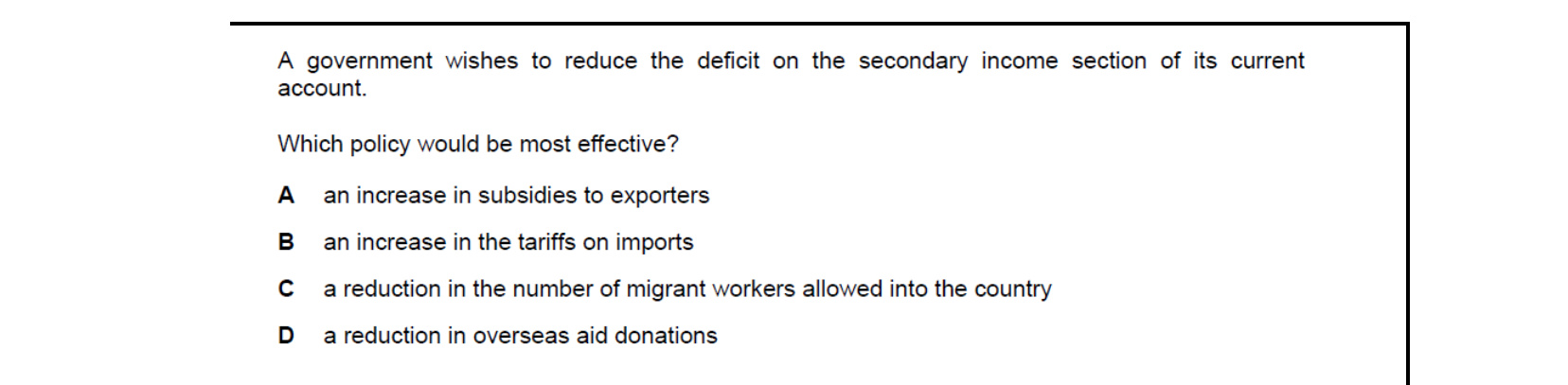
The secondary income balance records transfer payments such as overseas aid and remittances. Tariffs, export subsidies and migrant labour controls affect trade and primary income, not transfers. A reduction in overseas aid donations directly cuts outward transfer payments recorded in secondary income, so it is the most effective policy for narrowing a secondary income deficit.
29.3The effect of monetary policy on the current account
Reducing the rate of growth of the money supply can lower the growth of spending on imports, but in practice the money supply is difficult to control directly.
Using the rate of interest to influence the current account is more complex. If an economy has a low rate of inflation and a current account deficit, its central bank may cut the interest rate to put downward pressure on a floating exchange rate. A lower exchange rate can make the country's products more internationally competitive, supporting exports and discouraging imports — at the risk of generating inflationary pressure. In contrast, a higher interest rate can be used to reduce consumer expenditure, lowering demand for imports and easing inflation. But higher interest rates may attract capital inflows and raise the floating exchange rate, reversing the original fall in import demand.
To reduce a current account surplus, a government may use expansionary monetary policy — raising the money supply and cutting the rate of interest in an attempt to boost consumer expenditure. It may also seek to engineer an appreciation of the exchange rate so that exports become more expensive abroad and imports cheaper at home.
Most monetary policy tools are unlikely to correct current account imbalances in the long run. They do not address the structural causes of a deficit — such as low productivity — and they have little long-term effect on the structural sources of a surplus, such as a high rate of innovation or ownership of scarce raw materials.
29.4The effect of supply-side policy on the current account
Supply-side policy tools work on the productive capacity of the economy and can reduce a current account deficit by making domestic products more price-competitive and by making domestic markets more attractive to investors.
Deregulation and privatisation can increase the competitive pressure on domestic firms to keep costs and prices low, raise quality and respond more quickly to changes in consumer demand. Higher government spending on education and training, and investment subsidies, can raise productivity by improving the skills of the labour force and the quality of capital equipment. The lower relative price of domestic output and the higher quality both tend to raise domestic firms' share of the home market and of foreign markets.
A skilled workforce and good-quality capital equipment can also attract foreign multinational companies to set up local branches in the country, in the expectation of producing good-quality products at low cost. Those branches may contribute directly to the country's exports. Trade union reform can give firms more flexibility to respond to changes in demand and may reduce industrial action, making foreign customers more confident in the reliability of supply from the country.
Supply-side policy is not a quick fix. Its benefits accrue over the long run. It is also not well suited to reducing a current account surplus, because its aim is to expand the quantity and quality of the country's resources rather than to contract demand. Where the objective is to correct a long-run deficit, however, supply-side policy is the type of policy that has the best chance of doing so durably.
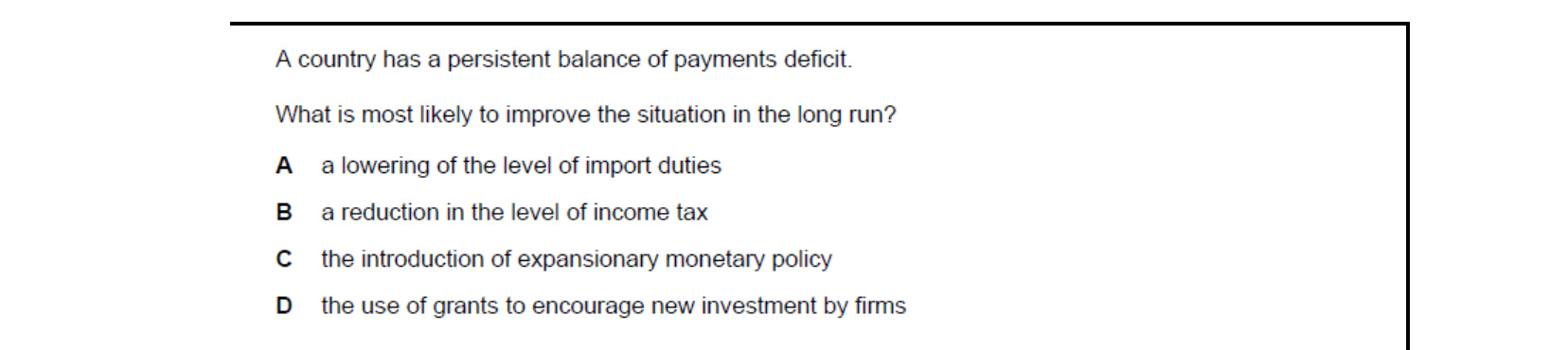
Long-run improvement in the current account depends on raising productive capacity and competitiveness. Cutting import duties, cutting income tax and easing monetary policy all stimulate demand and imports without addressing supply. Grants encouraging new investment by firms expand productive capacity, raise productivity and improve quality and cost competitiveness, durably strengthening the trade balance in the long run.
29.5The effect of protectionist policy on the current account
Protectionist policy can be used to encourage domestic consumers and firms to switch from imports to domestic substitutes. A government could, for example, impose a tariff on imports or raise an existing tariff. This works most effectively when the country has high-quality domestic substitutes available.
There are two important constraints. First, imposing tariffs against trading partners inside a trade bloc is normally not an option, since members of a trade bloc agree to abolish internal tariffs. Second, raising tariffs against countries outside a bloc carries two risks: trading partners may retaliate with tariffs of their own, and protected domestic firms may feel less pressure to become more efficient.
Key concept link — Efficiency and inefficiency
In considering how domestic firms respond to being protected from foreign competition, it is useful to make use of the key concept of efficiency. Domestic firms may feel less pressure to seek to be productively, allocatively and dynamically efficient if imports become more expensive due to the imposition of tariffs.
When judging whether a government should act to correct an imbalance in the current account, the size, duration and cause of the imbalance all matter. A small, short-term deficit caused by imports of investment goods is very different from a large, persistent deficit caused by structural weakness in the economy, and calls for different policy responses.

Promoting international trade means encouraging exports and imports to flow. Decreasing existing quotas only loosens a barrier already there; interest rates and wage subsidies act on the domestic economy, not directly on trade. Subsidies paid to export industries directly lower the cost of selling abroad, making domestic goods more competitive in foreign markets and so directly promoting international trade.
End-of-chapter practice
Past-paper questions from CIE 9708. Pick A, B, C or D. Answers are saved on this device — press Download report (PDF) at the top to save them.
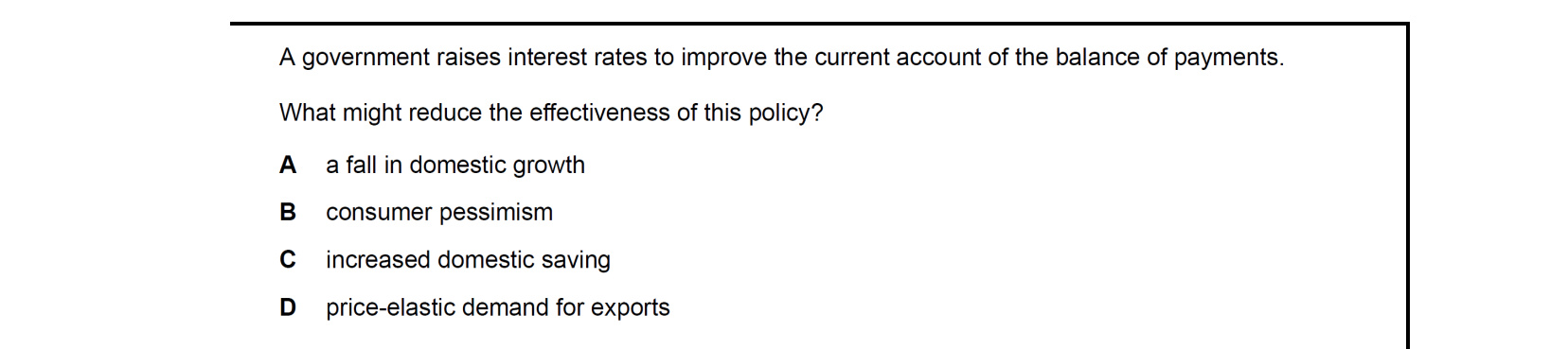
Higher interest rates work by curbing domestic demand, including demand for imports, and by attracting hot money that raises the exchange rate. A rise in the exchange rate worsens exports, so the policy only succeeds if export demand is inelastic. Price-elastic demand for exports means a stronger currency causes a more-than-proportionate fall in export revenue, undermining the improvement and so reducing the policy's effectiveness.
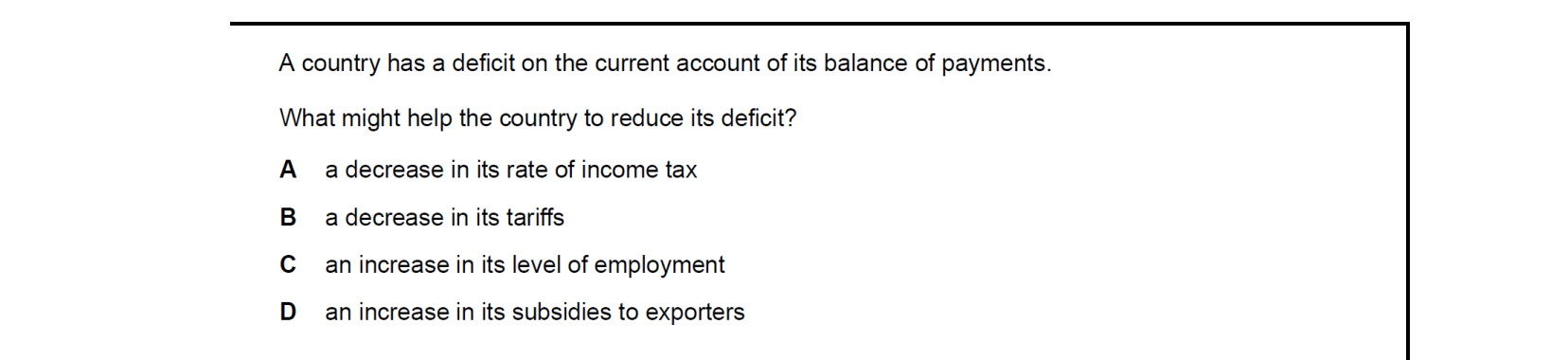
Cuts in income tax, lower tariffs and higher employment all boost spending, much of it on imports, so they tend to widen rather than narrow a current account deficit. Increasing subsidies to exporters directly lowers exporters' costs, making domestic goods more competitive abroad and raising export earnings, which helps reduce the current account deficit.

A deficit worsens when imports rise relative to exports. Deflationary policy curbs imports; export subsidies and tariffs both help the balance. Rising prices of essential imported raw materials raise the import bill — and because the imports are essential, demand is inelastic so spending on them rises. This widens the trade gap and worsens the current account deficit.
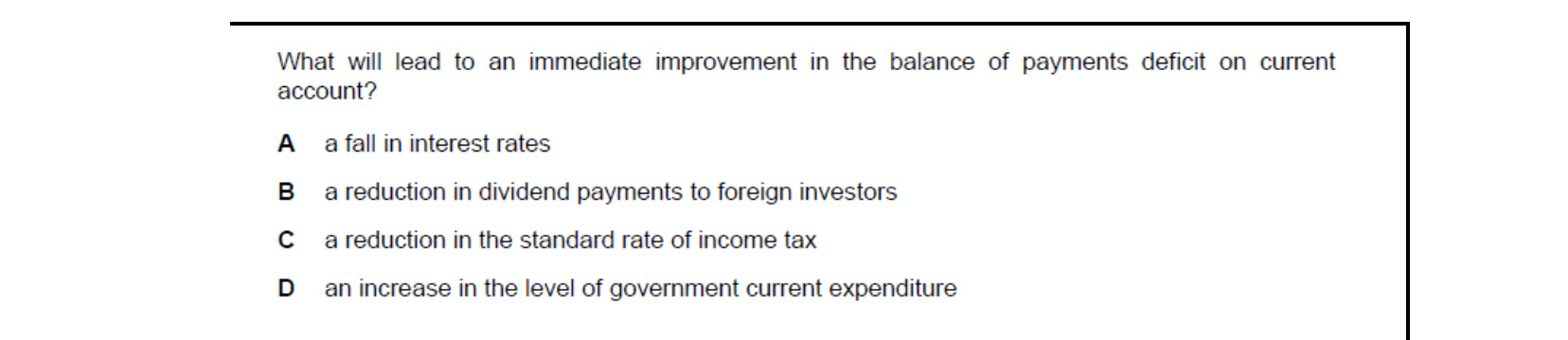
An immediate improvement means a same-period rise in net inflows on the current account. Lower interest rates, lower income tax and higher government spending all raise demand and imports, worsening the deficit. A reduction in dividend payments to foreign investors immediately cuts an outflow on the primary income account, directly and instantly improving the current account balance.

A current account deficit is reduced by curbing spending on imports or making exports more competitive. Higher interest rates tighten credit, reduce domestic spending and curb import demand, while attracting capital that supports the currency. The other options — easier money, lower export subsidies, lower direct tax — all stimulate import-intensive spending or weaken export competitiveness, so increasing interest rates is the correct policy.
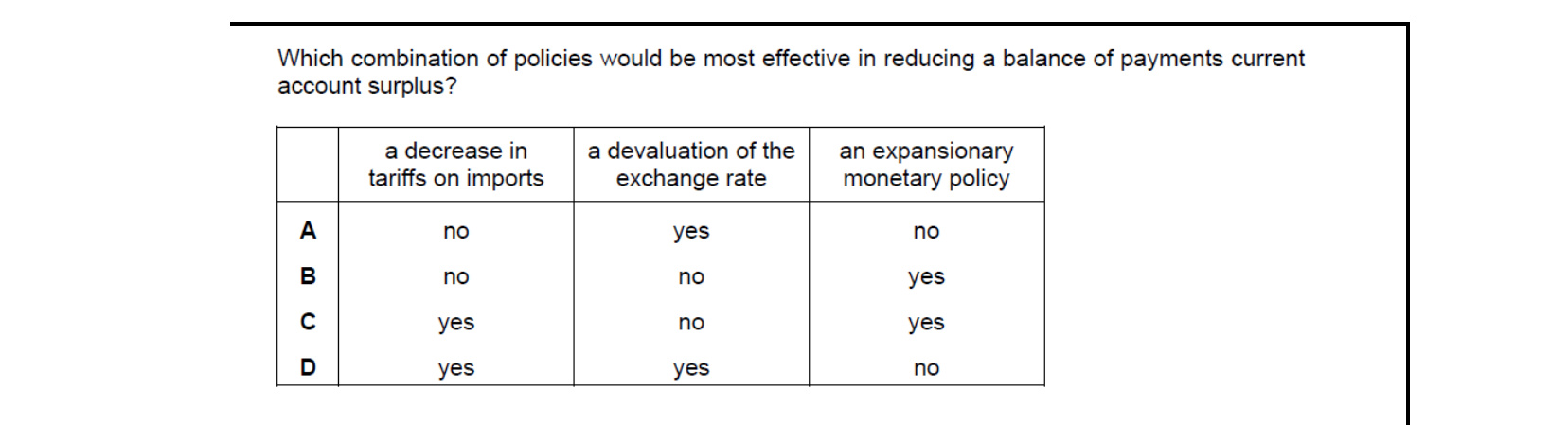
To reduce a current account surplus, policies must raise imports or curb exports. Devaluation cheapens exports and worsens a surplus, so that lever is wrong. Cutting tariffs on imports raises import demand, and expansionary monetary policy raises overall spending including on imports — both reduce the surplus. So the right combination is cutting tariffs and easing monetary policy, with no devaluation.
Attempt the practice questions above to build your score.
Self-evaluation checklist
After studying this chapter, you should be able to:
- Understand that governments usually aim to ensure export revenue equals import expenditure in the long run; in the short run a current account surplus may benefit an economy
- Explain how fiscal policy tools may be used to reduce a current account deficit on the balance of payments
- Explain how monetary policy tools may be used to reduce a current account surplus
- Explain how supply-side policy tools may be used to reduce a current account deficit
- Explain how protectionist policy tools may be used to reduce a current account deficit
Want more practice? Drill this chapter's past-paper MCQs (27 questions) →