Chapter 28 — Exchange Rates
Cambridge International AS & A Level Economics (9708) · Unit 6.4 · 4th edition coursebook
Learning objectives
- Define the meaning of an exchange rate.
- Explain how a floating exchange rate is determined.
- Explain the difference between depreciation and appreciation of a floating exchange rate.
- Analyse the causes of changes in a floating exchange rate.
- Discuss, using AD/AS analysis, the impact of exchange rate changes on the domestic economy's equilibrium national income and the level of real output, the price level and employment.
Key terms
- floating exchange rate
- An exchange rate that is determined by the market forces of demand and supply.
- depreciation
- A decrease in the international price of a currency caused by market forces.
- appreciation
- An increase in the international price of a currency caused by market forces.
- hot money flows
- Flows of money moved around the world to take advantage of changes in interest rates and exchange rates.
28.1The exchange rate
The foreign exchange rate is the price of one currency expressed in terms of another — the price at which units of the domestic currency can be exchanged for units of a foreign currency. A change in the exchange rate alters the foreign-currency price of the country's exports and the domestic-currency price of its imports. A rise in the value of the domestic currency makes the country's exports more expensive in foreign currencies and its imports cheaper in domestic currency; a fall in the value of the domestic currency does the reverse.
It is important to distinguish between the external and internal value of a currency. The exchange rate measures the external value — what a unit of the currency is worth in terms of foreign currency. The domestic price level measures the internal value — what a unit of the currency buys in terms of domestic goods and services. The two can move in different directions.
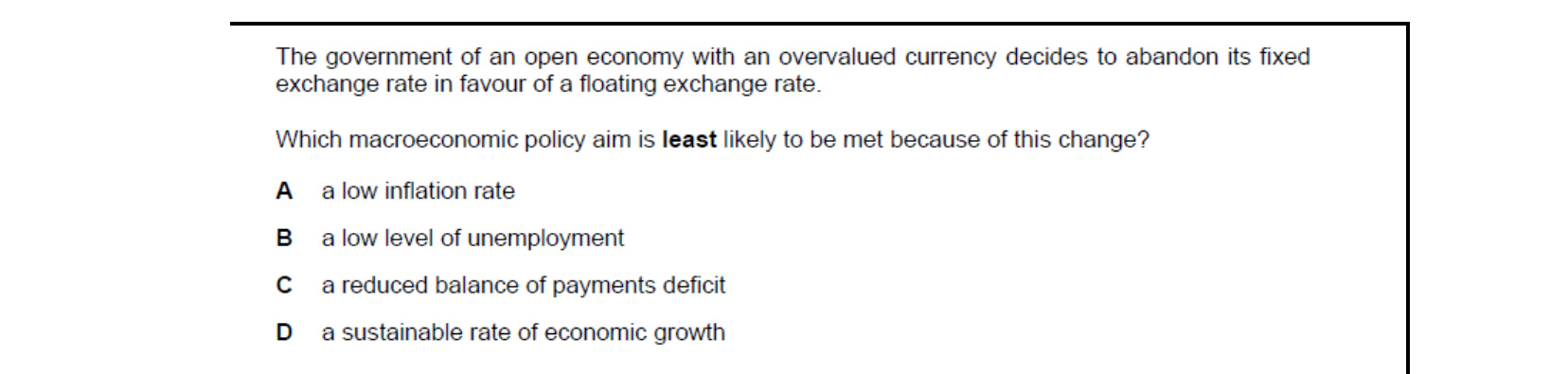
An overvalued currency that is allowed to float will fall toward its market level — a depreciation. A cheaper currency raises import prices and stimulates exports, both of which feed into higher inflation. So the policy objective least likely to be met by abandoning the overvalued peg is a low inflation rate. The other aims — lower unemployment, smaller BoP deficit, sustainable growth — are likely to be helped.

Under a floating regime the central bank does not need to use interest rates or reserves to defend a target exchange rate. That frees monetary policy to pursue domestic objectives (inflation, output, employment). So a floating system gives the government more independence in policy making — its main attraction relative to a fixed regime.
28.2How a floating exchange rate is determined
A floating exchange rate is one whose value is determined by market forces. Currencies are bought and sold on the foreign exchange market, which has no single physical location: it is a network of financial institutions that buy and sell foreign currency on behalf of private and business customers. Very large values of currency change hands on any single day. The price of a currency is determined by the relative strengths of demand for and supply of that currency.
Currency traders buy the domestic currency to enable their customers to purchase the country's goods and services, to invest in the country, or to speculate on a future rise in the currency's value. Financial institutions also speculate on currency movements on their own account. The currency is sold to obtain foreign currency to buy imports, to invest abroad, or in the expectation that the currency will fall in the future.
28.3Depreciation and appreciation of a floating exchange rate
A depreciation is a fall in the value of a currency brought about by market forces. A depreciation reduces the foreign-currency price of the country's exports and raises the domestic-currency price of its imports. Diagrammatically, an increase in the supply of the currency on the foreign exchange market shifts the supply curve to the right; with the demand curve unchanged, the equilibrium price (the exchange rate) falls and the quantity of currency traded rises (see Figure 28.2).
An appreciation is a rise in the value of a currency brought about by market forces — typically by an increase in demand for the currency, a decrease in supply, or both. An appreciation raises the foreign-currency price of exports and lowers the domestic-currency price of imports. Diagrammatically, a fall in the supply of the currency (for example, when residents of one country buy fewer of another country's goods and so need to convert fewer of their own units into that country's currency) shifts the supply curve of that currency leftwards and raises its price (see Figure 28.3).
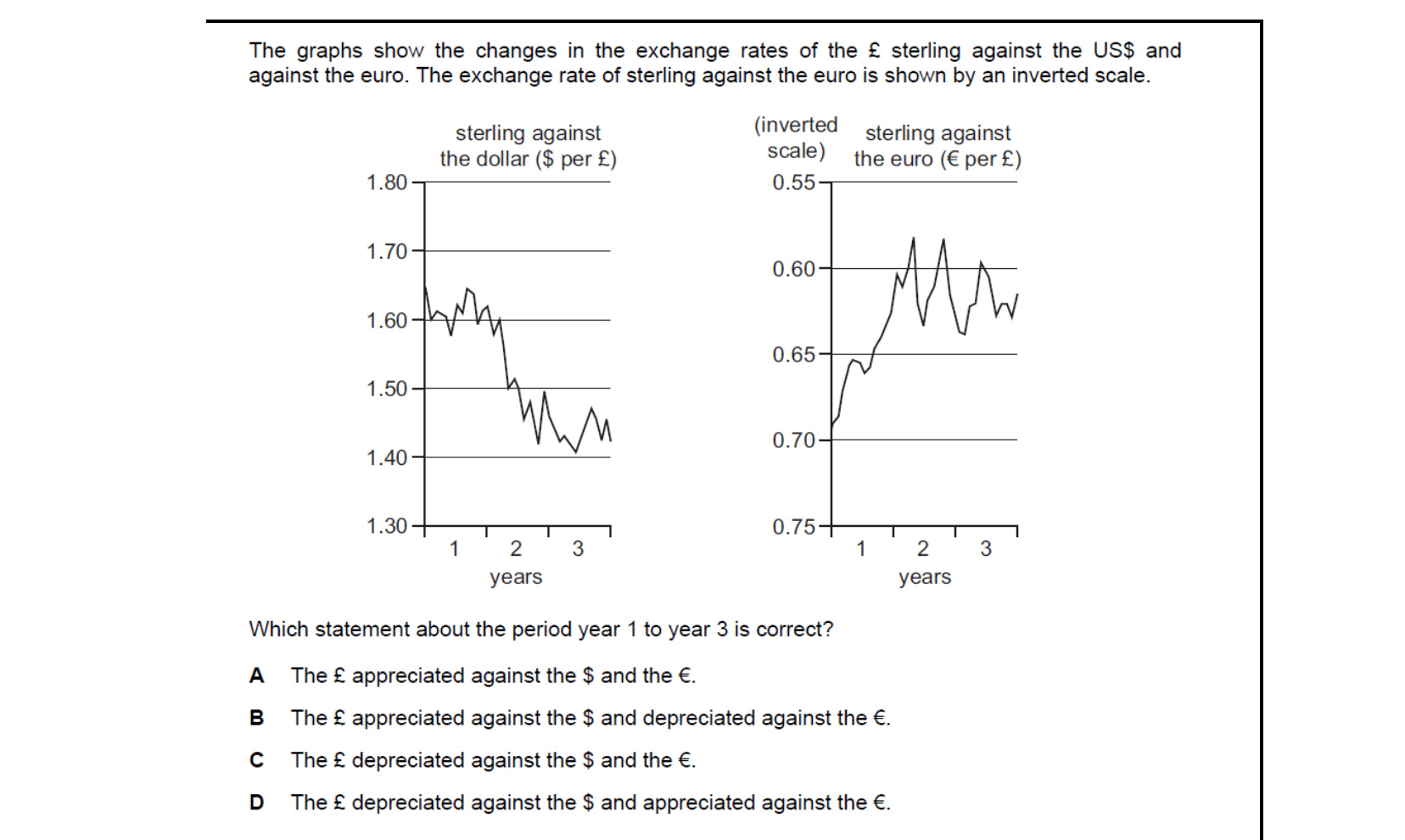
The sterling/dollar graph falls from 1.80 to about 1.30 — sterling depreciated against the dollar. The sterling/euro graph is on an inverted scale, so a visible upward movement actually means fewer euros per pound — sterling also depreciated against the euro. Both bilateral rates show depreciation, so the correct statement is that the pound depreciated against both the dollar and the euro.
28.4The causes of changes in a floating exchange rate
Because a floating exchange rate is determined by demand and supply, anything that shifts either curve will change the rate. The key drivers are the trade flows, investment flows and speculative flows that generate demand for and supply of the currency.
Causes of an increase in demand for the currency
Demand for the currency rises when foreigners need more of it. Foreigners may need more of the currency to buy a higher value of exports — for example, because the country's relative inflation rate has fallen, productivity has risen, the quality of its products has improved or incomes abroad have risen. Foreigners may also want more of the currency to buy shares in the country's firms when the country's economic prospects have improved, or to open accounts in the country's banks when interest rates rise.
Hot money flows — short-term movements of capital between countries seeking the highest interest rates or capital gains from expected exchange-rate movements — can account for a large proportion of currency purchases. Foreign firms may also buy the currency to set up branches in the country, perhaps in response to rising labour productivity, a growing market, or as a way of getting round trade restrictions.
Causes of an increase in supply of the currency
Supply of the currency rises when residents need more foreign currency and so offer more of their own. This happens when they buy more imports, undertake foreign travel, buy more of another country's government bonds, set up firms abroad, or in anticipation of a fall in the value of the currency or in domestic interest rates.
An increase in demand for the currency pushes its price up; an increase in supply pulls its price down. A demand-and-supply diagram is the standard way of analysing the cause of a particular change in the exchange rate.

Raising interest rates makes financial assets denominated in the currency more attractive, drawing in foreign capital and increasing demand for the currency on the foreign exchange market. The currency appreciates. Tariffs have ambiguous effects, cutting income tax raises AD and inflation (weakening the currency), and selling the currency directly depresses its value.
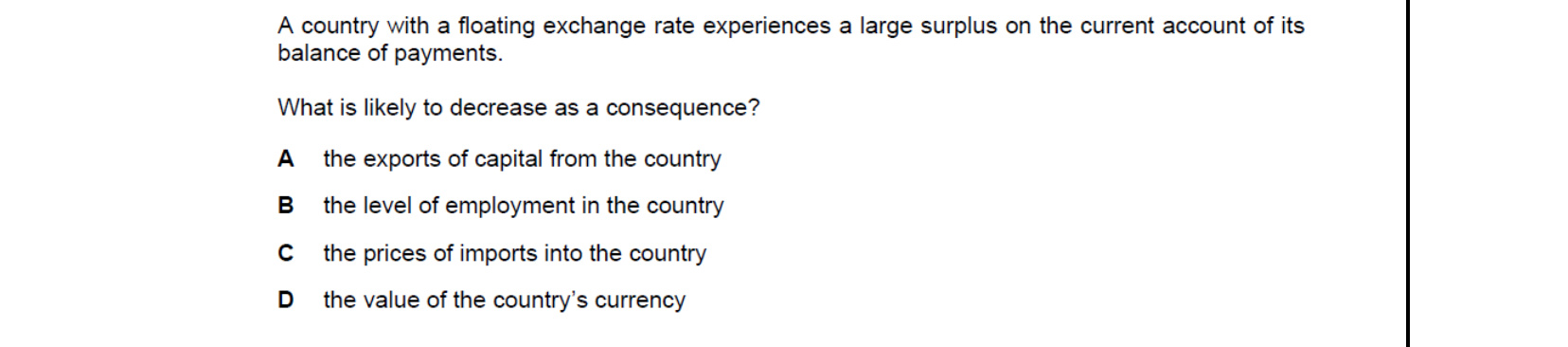
A large current account surplus means net demand for the country's currency rises (foreigners need it to buy the country's exports). Under a floating regime, the currency appreciates. A stronger currency lowers the domestic-currency price of imports, so the prices of imports into the country fall — option C.

Capital flows toward higher returns. An increase in foreign interest rates raises the return available abroad relative to home, so domestic savers and investors move funds out of the country to chase the higher foreign yield — a capital outflow. The other options either attract capital inwards or have an ambiguous effect.
28.5The impact of exchange rate changes on the domestic economy
A change in the exchange rate has knock-on effects on national income, output, the price level and employment. Analysis uses the aggregate demand / aggregate supply framework.
Depreciation: national income and real output
A depreciation makes exports cheaper in terms of foreign currency and imports more expensive in terms of domestic currency. Domestic firms can therefore sell more abroad, and some domestic consumers switch from imports to domestically produced substitutes. Some foreign consumers switch from products produced by firms in other countries to the country's exports. Net exports rise. Higher net exports increase aggregate demand, which in turn raises real output and national income, provided that the economy has spare capacity. In the standard diagram, the aggregate demand curve shifts to the right against an upward-sloping aggregate supply curve, raising both real GDP and the price level at the new equilibrium (see Figure 28.4).
Depreciation: the domestic price level
A depreciation tends to raise the domestic price level. Higher aggregate demand, as the economy approaches full capacity, bids up the prices of increasingly scarce resources. Finished imported products that are still purchased are now more expensive, and many of them appear in the country's consumer price index. The cost of imported raw materials rises, pushing up firms' costs of production. Domestic firms also feel less competitive pressure from cheaper imports and so may be less restrained in raising prices.
Depreciation: employment
If a depreciation does raise aggregate demand, firms producing for both the domestic and the export market are likely to take on more workers to expand output. Cyclical unemployment therefore tends to fall.
Appreciation: national income and real output
An appreciation makes exports more expensive in terms of foreign currency and imports cheaper in domestic currency. Demand for domestic products is therefore likely to fall — both abroad and at home. The result may be a slowdown in economic growth or, in more severe cases, a recession. With lower real output, incomes also tend to fall (see Figure 28.5).
Appreciation: domestic inflation
An appreciation can reduce inflationary pressure, especially when the economy is operating close to or at full capacity. Where aggregate demand would otherwise have grown enough to push prices up, the slower growth in aggregate demand caused by lower net exports results in a lower inflation rate than would otherwise have occurred. A higher exchange rate can also shift the aggregate supply curve to the right by lowering the cost of imported raw materials; the price of imported finished products falls, and competitive pressure from cheaper imports forces domestic firms to restrain price rises in order to maintain sales at home and abroad.
Appreciation: unemployment
An appreciation may raise unemployment. If aggregate demand decreases, firms may stop replacing workers who retire and may make some workers redundant.
A change in the exchange rate may take time to affect the domestic economy. Firms and consumers first have to recognise that prices have changed; then they need time to find substitutes; and firms may already be locked into contracts to buy or supply products at previously agreed prices for some months ahead.
End-of-chapter practice
Past-paper questions from CIE 9708. Pick A, B, C or D. Answers are saved on this device — press Download report (PDF) at the top to save them.
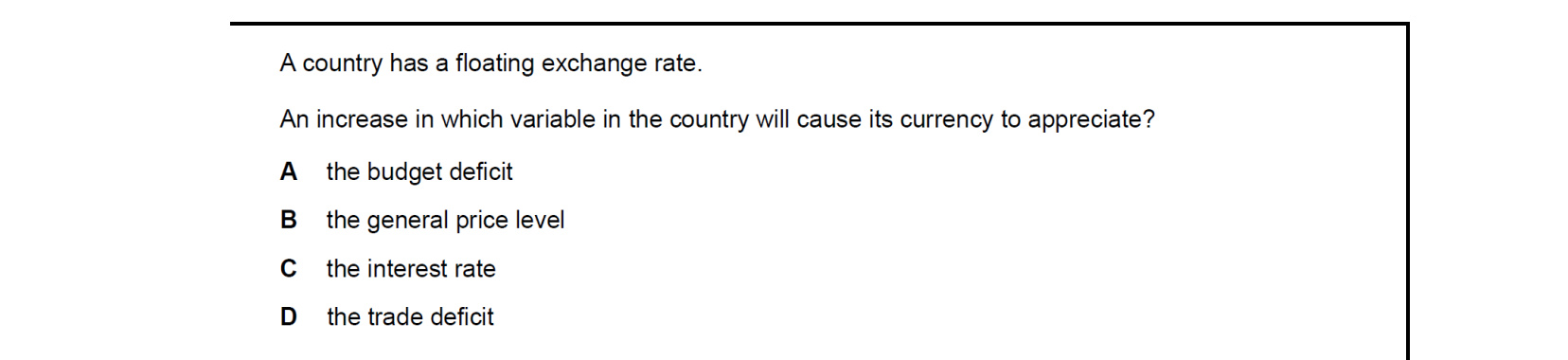
An appreciation requires higher net demand for the currency. A higher interest rate attracts foreign capital seeking the better return, raising demand for the currency on the forex market — so the currency appreciates. A higher budget deficit, higher price level or larger trade deficit tend to weaken the currency, not strengthen it.
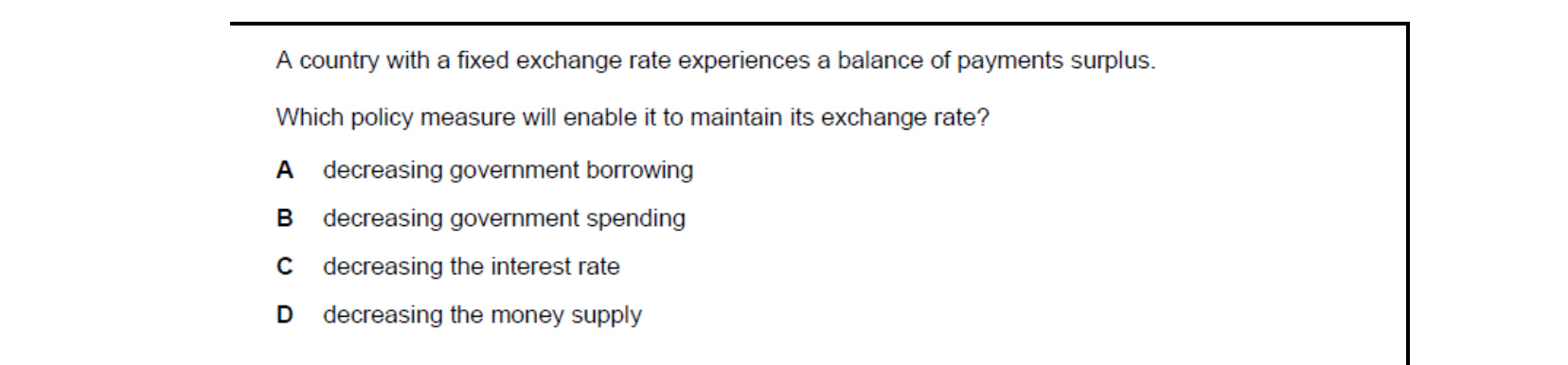
A balance of payments surplus puts upward pressure on the currency. To keep the rate fixed, the authorities need to reduce demand for (or increase supply of) the currency. Lowering the interest rate discourages capital inflows and encourages outflows, reducing demand for the currency and so relieving the upward pressure — maintaining the peg.
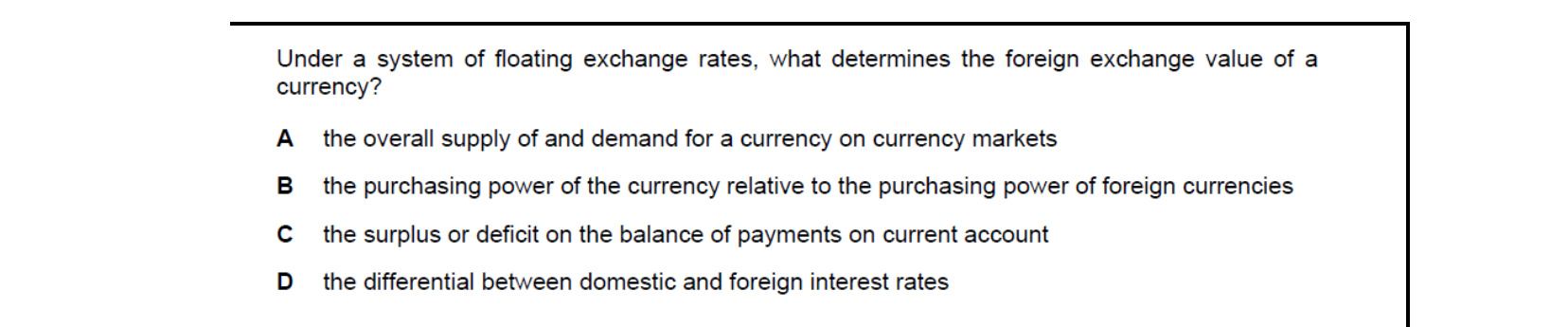
By definition, a floating exchange rate is determined by the interaction of supply and demand for the currency on the foreign exchange market. Purchasing power parity, the current account balance and interest rate differentials all influence supply and demand, but the proximate determinant of the forex value is the overall supply of and demand for the currency itself.
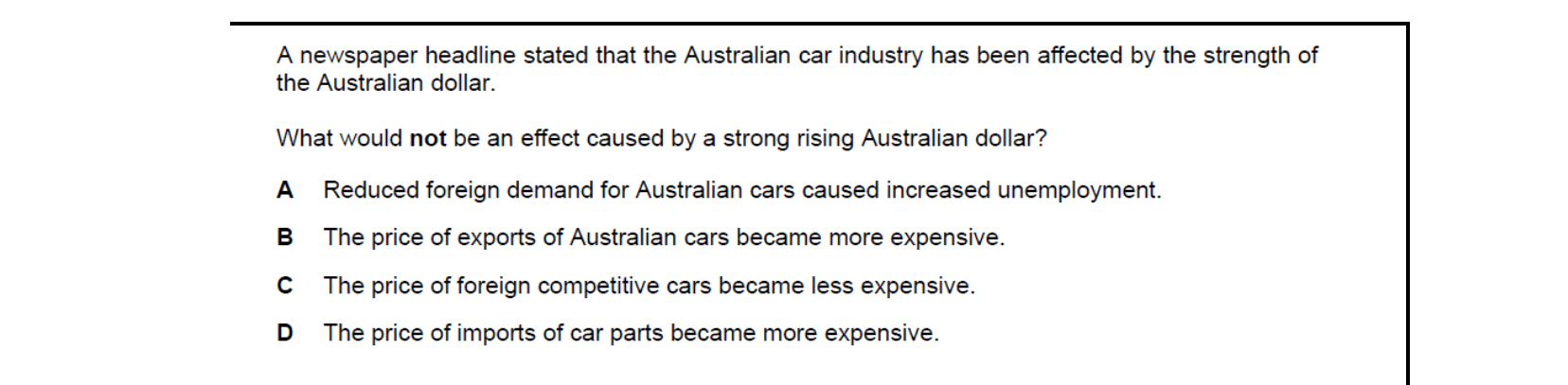
A strong, appreciating Australian dollar makes Australian exports dearer in foreign currency (so foreign demand falls and unemployment rises) and makes imports cheaper in Australian dollars — including imported car parts and foreign competitive cars. So saying that the price of imports of car parts became more expensive is the opposite of what a stronger currency does — that effect would NOT occur.
Attempt the practice questions above to build your score.
Self-evaluation checklist
After studying this chapter, you should be able to:
- Understand that an exchange rate is the price of one currency in terms of a foreign currency
- Explain how a floating exchange rate is determined by demand for and supply of the currency
- Explain why a depreciation is a fall in the price of a currency whereas an appreciation is a rise in the price of a currency
- Consider how changes in the demand for and supply of a currency will cause a change in the price of the currency in the case of a floating exchange rate
- Discuss how a change in the exchange rate can influence the current account position, national income, level of real output, price level and employment
Want more practice? Drill this chapter's past-paper MCQs (75 questions) →