Chapter 27 — Current Account of the Balance of Payments
Cambridge International AS & A Level Economics (9708) · Unit 6.3 · 4th edition coursebook
Learning objectives
- Explain the components of the current account of the balance of payments.
- Calculate the balance of trade in goods, in services and in goods and services and overall current account balance.
- Analyse the causes of imbalance in the current account of the balance of payments.
- Discuss the consequences of imbalance in the current account of the balance of payments for the domestic and external economy.
Key terms
- dividend payments
- A share of a firm's profits paid to its shareholders.
- exchange rate
- Price of one currency in terms of another currency.
- balance of payments account
- A record of a country's economic transactions with the rest of the world over a year.
- capital account
- Within the balance of payments, a record of the sale and purchase of copyrights, patents, trademarks, and money brought into the country by immigrants and taken out by emigrants.
- financial account
- Within the balance of payments, a record of the transfer of financial and capital assets between the country and the rest of the world.
- imbalance (in the current account of the balance of payments)
- Debit items in the current account not equalling credit items.
- current account deficit (of the balance of payments)
- The value of debit items on the current account exceeding the value of credit items.
- current account surplus (of the balance of payments)
- The value of credit items on the current account exceeding the value of debit items.
- balance (in the current account of the balance of payments)
- Debit items on the current account equalling credit items.
27.1What is a country's balance of payments?
A country's balance of payments account is a record of all the economic transactions between residents of that country and residents of the rest of the world over a given period — usually a year. The balance of payments has three main parts: the current account, the capital account, and the financial account.
Money coming into the country gives rise to credit items, which are recorded with a positive sign. Money going out of the country gives rise to debit items, recorded with a negative sign. The current account, which is the focus of this chapter, records flows arising from international trade in goods and services and from current income and transfer flows. The capital and financial accounts record movements of assets — for example, sales and purchases of intellectual property, and transfers of financial and capital assets — and are covered in later chapters.
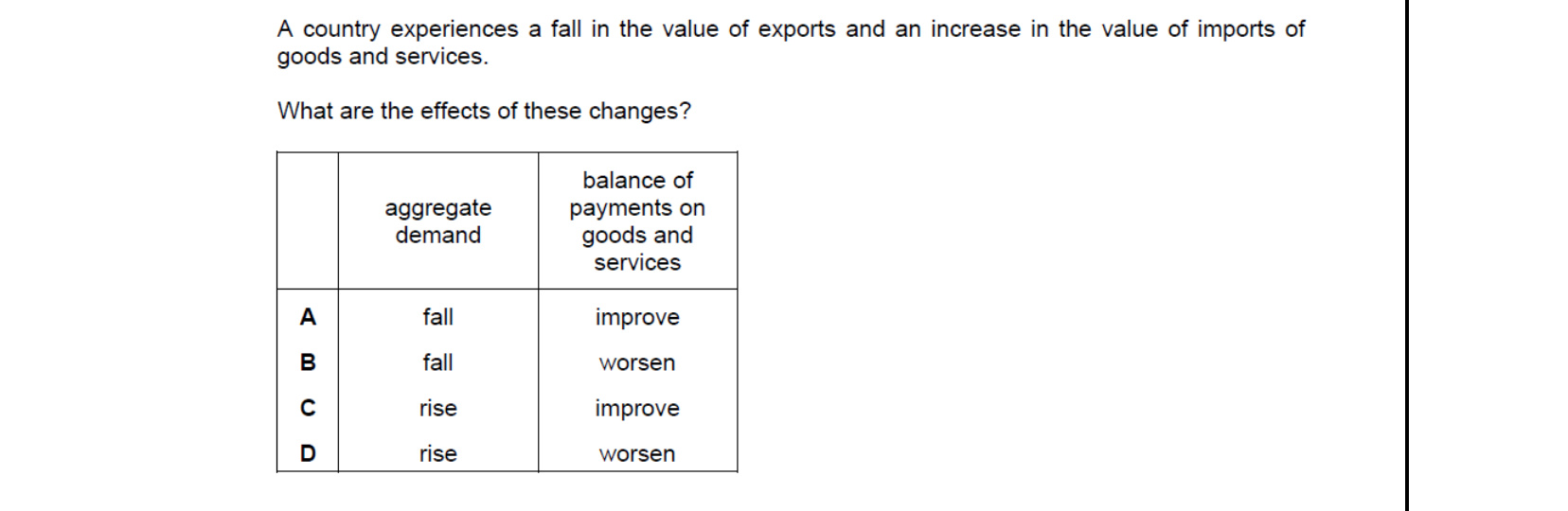
Net exports (X − M) is a component of AD; a fall in X with a rise in M reduces (X − M) and so reduces AD. The balance of payments on trade in goods and services is also X − M, so it deteriorates (worsens). The combination is therefore a fall in AD with a worsening trade balance — option B.
27.2Components of the current account of the balance of payments
The current account has four components: trade in goods, trade in services, primary income and secondary income.
Trade in goods
Trade in goods covers exports and imports of physical products such as cars, televisions and clothing. Exports give rise to credit items and imports give rise to debit items. The trade in goods balance — sometimes called the visible balance or the merchandise balance — is export revenue from goods minus expenditure on imported goods. A trade in goods surplus exists when export revenue from goods is greater than expenditure on imports of goods; a deficit exists when expenditure on imported goods exceeds the revenue from exported goods.
Trade in services
Trade in services covers exports and imports of services — sometimes referred to as invisibles. Examples include shipping, tourism, banking and insurance. The trade in services balance is the revenue from exports of services minus expenditure on imported services. A deficit on the trade in services arises when the country buys more services from abroad than it sells abroad.
Primary income
Primary income records the income earned by residents on assets and labour they supply abroad and, in the opposite direction, income earned by non-residents from assets and labour supplied in the country. Investment income — profits, interest and dividend payments — is the main category. Dividends paid on foreign shares held by residents appear as credit items; interest paid to foreign account-holders by domestic banks appears as a debit item. Primary income also includes 'employees' compensation' — wages earned by the country's residents for working in another country and paid for by residents of that country.
Secondary income
Secondary income records payments and receipts for which there is no matching exchange of an actual good or service. Government transfers — such as payments to and receipts from international organisations and foreign aid — fall into this category. Transfers by private individuals are also recorded here. The clearest example is workers' remittances: money sent back home by people working in another country for a year or more. In some countries workers' remittances form a large credit item.
Current account balance
The current account balance is the overall sum of the four components. A current account deficit exists when the combined debit items on the four components exceed the combined credit items. A current account surplus exists when combined credit items exceed combined debit items.
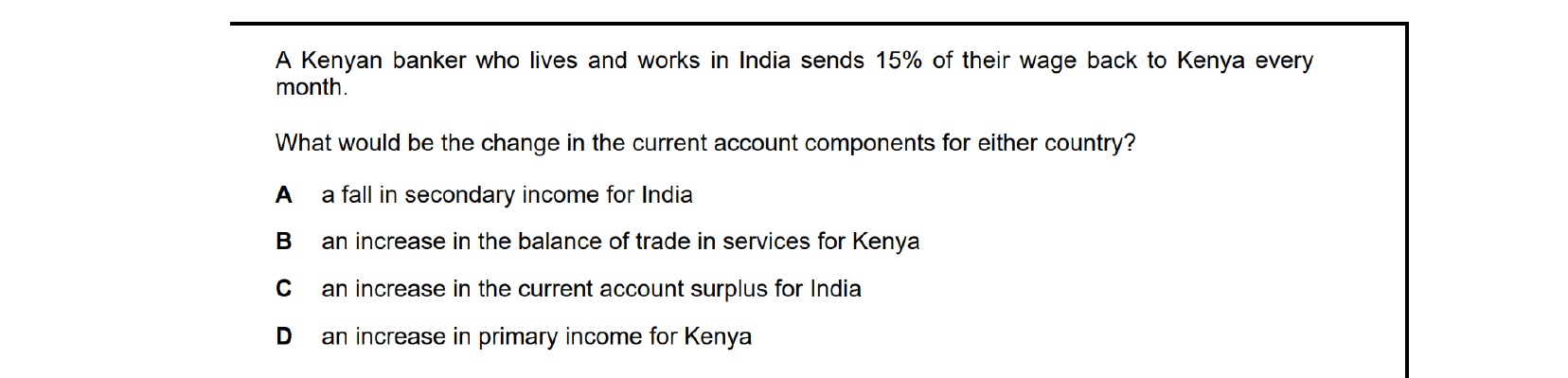
Workers' remittances sent abroad are debit entries on secondary income (current transfers) of the sending country. The banker living and working in India sends money back to Kenya, so India records an outflow on secondary income — its secondary income balance falls. The flow is a credit on Kenya's secondary income, not on its trade in services or primary income.
27.3Balance and imbalances (deficit and surplus) in the current account of the balance of payments
For an individual country, the current account is usually not exactly in balance: there is normally an imbalance between credit and debit items, taking the form of either a surplus or a deficit. At the global level, however, the value of all the world's current account deficits is matched by the value of all the world's current account surpluses, because every credit item for one country is a debit item for another. The world's current account is therefore always in balance overall, with total credits equal to total debits.
27.4Current account balance calculations
Each balance in the current account is calculated as exports minus imports for the relevant category, with debit items subtracted from credit items.
Balance of trade in goods
The balance of trade in goods is the value of exports of goods minus the value of imports of goods. If a country exports a smaller value of goods than it imports, the balance of trade in goods is in deficit (a negative figure).
Balance of trade in services
The balance of trade in services is the value of exports of services minus the value of imports of services. A country that exports more services than it imports has a surplus on the trade in services.
Balance of trade in goods and services
The balance of trade in goods and services — sometimes called the total trade balance — is the sum of the balance of trade in goods and the balance of trade in services. A deficit on goods may be partly or wholly offset by a surplus on services, or vice versa.
Current account balance
The overall current account balance is obtained by adding the balance of primary income and the balance of secondary income to the balance of trade in goods and services. A positive figure indicates a surplus; a negative figure indicates a deficit. In practice this means that a country can run a trade deficit and still have a current account surplus if its primary and secondary income surpluses are large enough, and vice versa.
A common error is to define a trade deficit as imports exceeding exports in quantity terms. The correct definition uses value: a trade deficit arises when the value of imports (price multiplied by quantity) exceeds the value of exports.

FDI flows are recorded on the financial account, not the current account. So a rise in foreign direct investment, as such, does not affect the current account balance directly. Changes in export/import prices, foreign aid flows (transfers) and exchange rates all flow through the trade, primary income or secondary income components of the current account.
27.5Causes of imbalances in the current account of the balance of payments
Imbalances on the current account arise for a variety of reasons. It is important to distinguish between causes that are temporary and largely self-correcting, and causes that are structural and indicate a deeper problem.
The causes of a current account deficit
A growing domestic economy. When firms expand output they often buy more imported raw materials and capital goods. Export revenue may also fall as some output is diverted from foreign to domestic customers. This kind of deficit is not usually a problem: it tends to be short-term and self-correcting, because as the imported inputs are used to produce additional output, export revenue may rise to match the higher import expenditure.
Declining economic activity in a country's trading partners. If trading partners experience recessions or slower growth, their demand for the country's exports falls or rises more slowly. A current account deficit arising from cyclical movements in the domestic economy or in trading partners' economies is sometimes called a cyclical deficit. It is usually not a serious concern because it tends to be temporary and self-correcting.
Structural problems. A deficit that persists in the long run is more worrying. It indicates that domestic firms are not internationally competitive and that the country may have to keep borrowing or attracting investment to finance the gap. Causes of a lack of international competitiveness include an overvalued exchange rate that the government has held up through intervention, a relatively high domestic inflation rate, and low labour and capital productivity. Low productivity, in turn, may reflect poor education and training and low rates of investment and innovation. A structural deficit will not correct itself.
The causes of a current account surplus
A declining domestic economy. A recession reduces consumer expenditure and investment expenditure, so demand for imports — both finished goods and raw materials — falls. A surplus that arises this way is not beneficial: it reflects weak domestic activity rather than any improvement in competitiveness.
Increasing economic activity in trading partners. When the country's trading partners are growing strongly, they buy more of its exports. The country's residents working abroad may also earn higher wages, some of which they send back as remittances.
Structural advantages. Firms in the country may be highly competitive because of good education and training, high investment and high rates of innovation. Low domestic inflation and a low exchange rate may also make the country's products price-competitive. The causes of a surplus are essentially the mirror image of the causes of a deficit.
27.6Consequences of imbalances in the current account on the economy
A current account deficit allows the residents of a country to consume more goods and services than the country produces — the country is said to be 'living beyond its means'. The deficit must be financed, either by attracting investment into the country or by borrowing. Both create future outflows: investment income paid to foreign owners of domestic assets, and interest paid on foreign debt. A widening current account deficit may also reduce aggregate demand (because net exports are falling), which can slow economic growth and raise unemployment.
A current account surplus may seem unambiguously good — the country is earning more from the rest of the world than it is spending. However, a surplus means that the country's residents are not enjoying as high a standard of living as the country's productive capacity could support. A persistent surplus, especially if accompanied by additions to the money supply, can generate inflationary pressure. Countries running deficits may also put political pressure on a surplus country to change its policies in order to reduce the surplus.
The significance of a current account imbalance is best judged not by the absolute monetary amount but by the size of the deficit or surplus as a percentage of the country's gross domestic product. A large deficit in monetary terms may be modest as a share of a large economy, while a much smaller monetary deficit may represent a serious imbalance in a small economy.
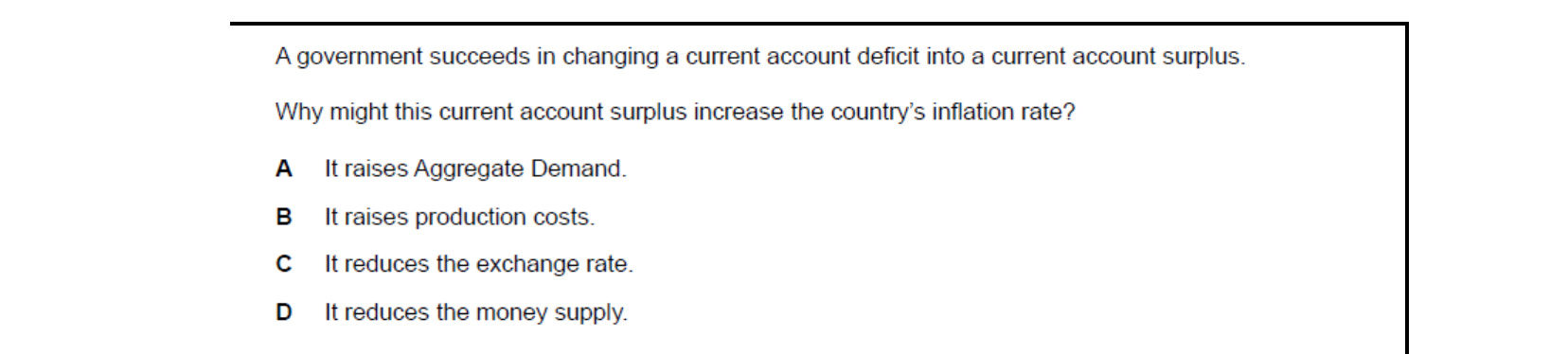
A current account surplus means net exports are positive: more is being added to AD by exports than is being subtracted by imports. The resulting rise in AD pulls up the price level — classic demand-pull inflation. It does not directly raise production costs, does not reduce the exchange rate (it tends to do the opposite) and does not reduce the money supply.
End-of-chapter practice
Past-paper questions from CIE 9708. Pick A, B, C or D. Answers are saved on this device — press Download report (PDF) at the top to save them.
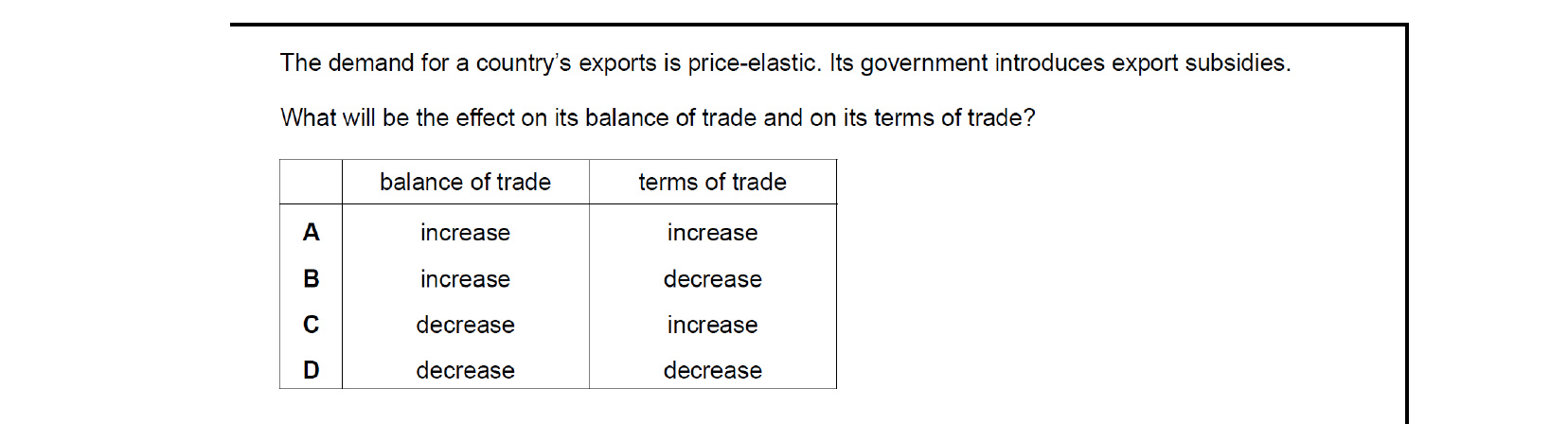
Export subsidies lower the price of exports on world markets. With price-elastic foreign demand, the quantity of exports rises proportionally more than the price falls, so total export revenue rises — improving the balance of trade. But the lower export price relative to import prices means a fall in the terms-of-trade ratio. The combination 'balance of trade increases / terms of trade decrease' is option B.
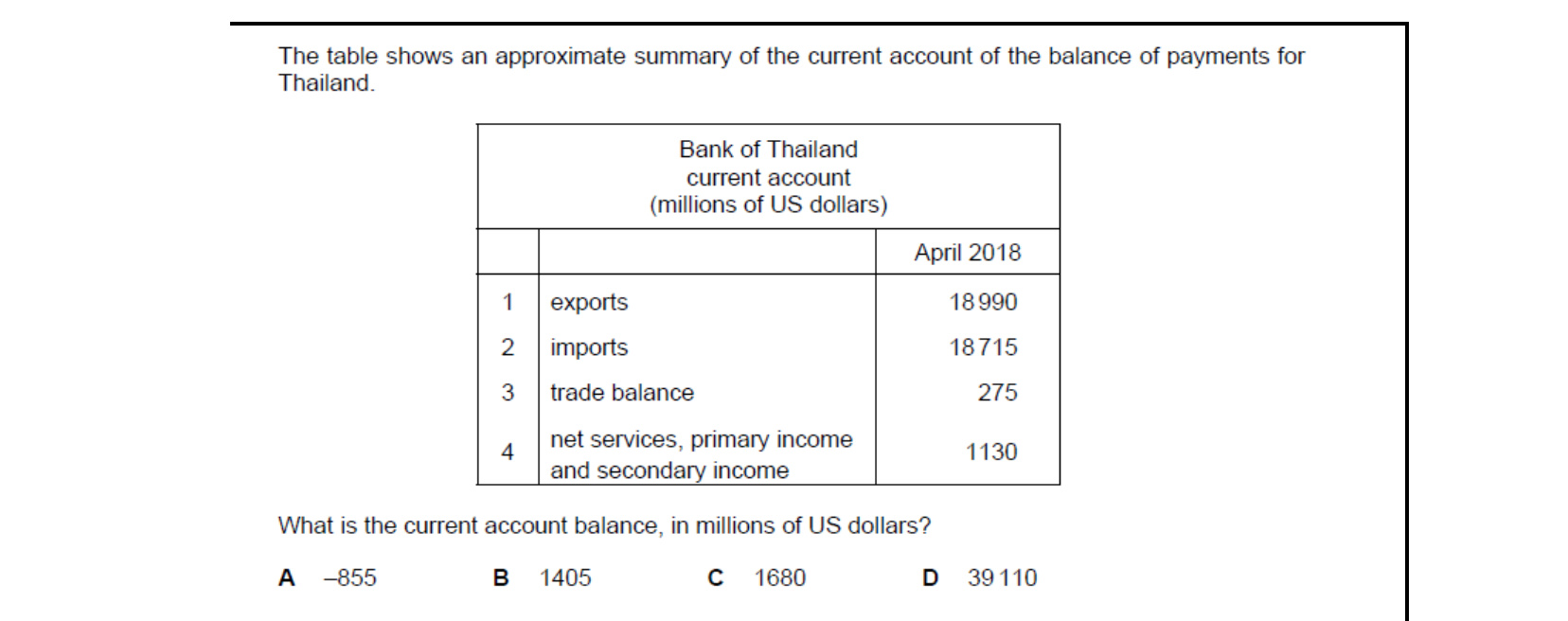
Current account = trade balance + net services, primary income and secondary income. From the table: trade balance = 275; net services + primary + secondary income = 1130. Current account = 275 + 1130 = 1405. The current account balance is therefore $1405m, matching option B.
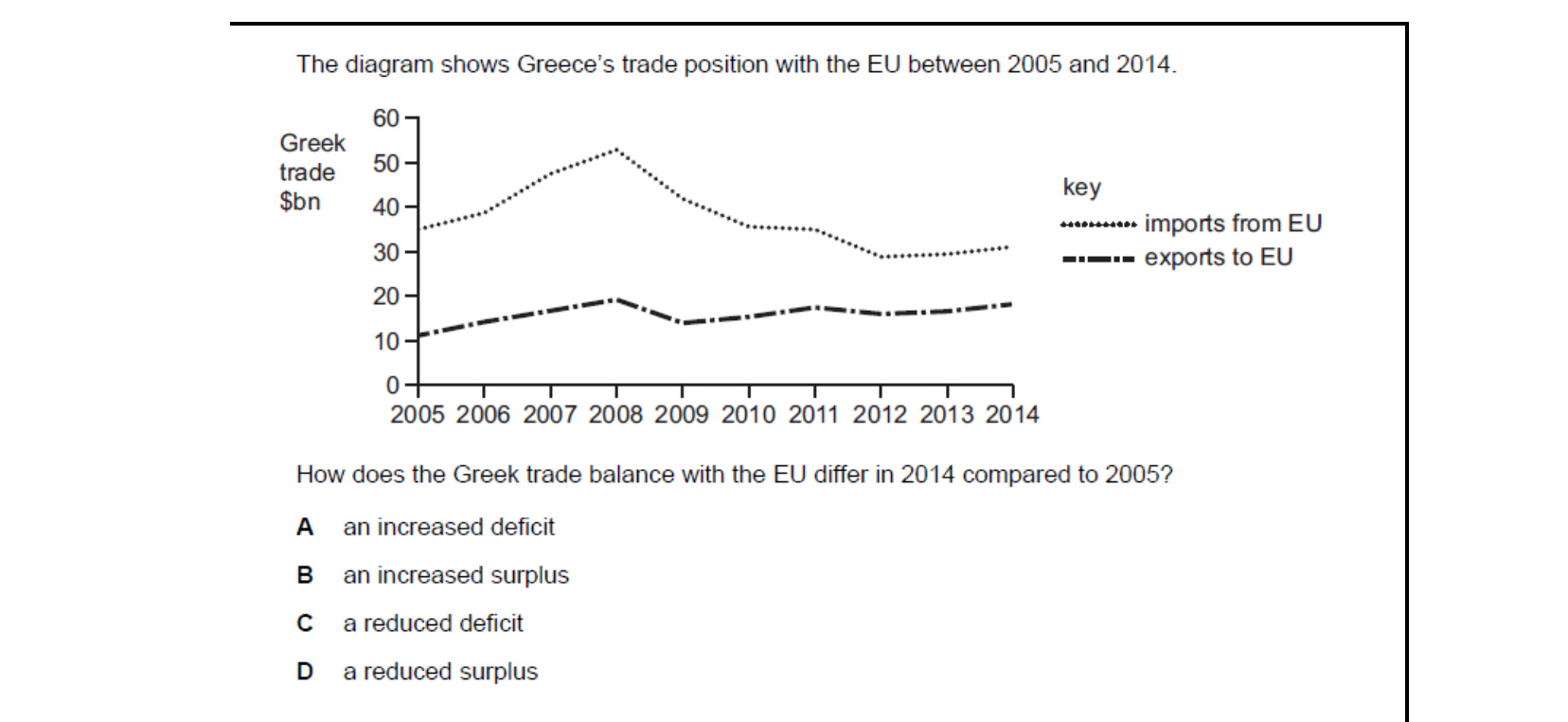
In 2005, Greek imports from the EU exceeded exports — a trade deficit. By 2014, the gap between imports and exports had narrowed: imports had fallen and exports had risen toward each other. So in 2014 Greece still had a trade deficit, but a smaller one — a reduced deficit, which is option C.
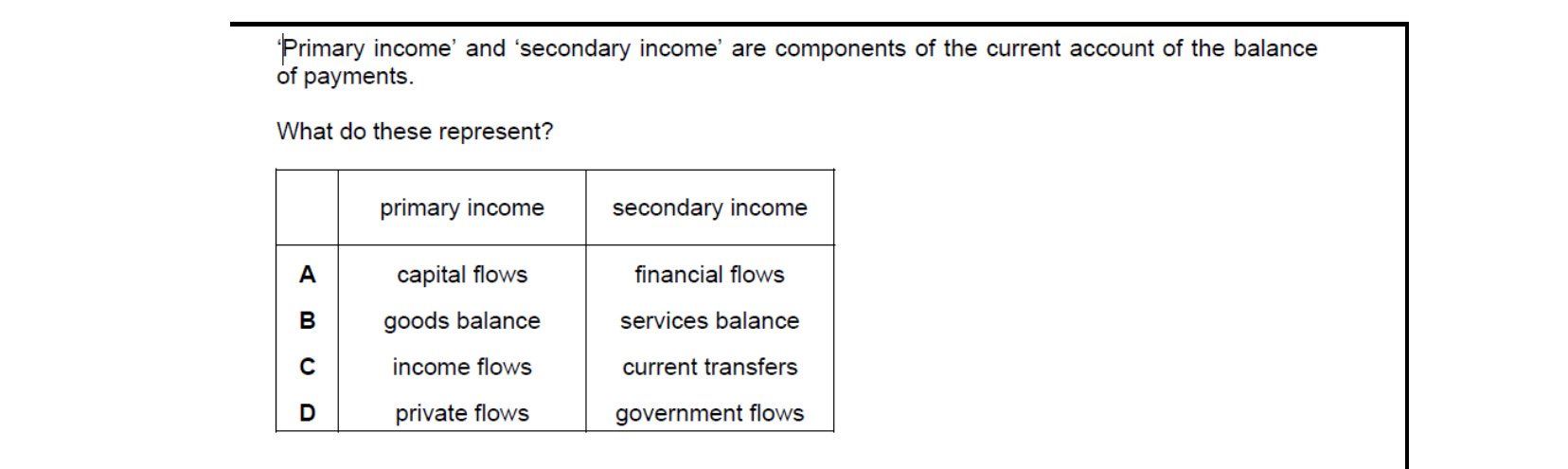
Primary income records the returns to factors of production used abroad — investment income (interest, dividends, profits) and employee compensation — i.e. income flows. Secondary income records transfers without a corresponding exchange — workers' remittances, foreign aid, gifts — i.e. current transfers. Option C captures both definitions accurately.

A current account surplus means net exports are positive and adding to AD. If AD is already excessive, the surplus contributes to demand-pull inflation. Reducing the surplus (by allowing imports to rise or exports to slow) trims AD and so eases inflation. Reducing the surplus would tend to raise unemployment and lower growth — it is the inflation objective that motivates the action.
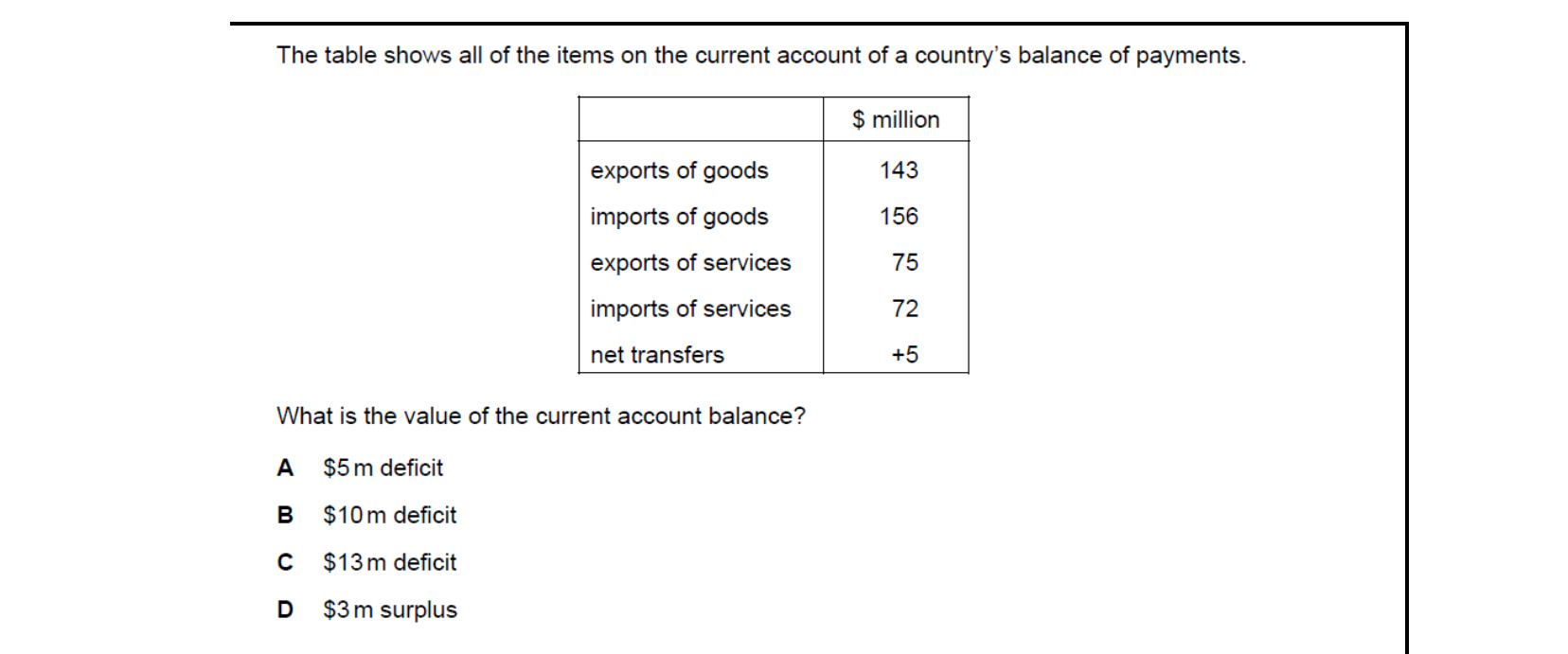
Current account = (X goods − M goods) + (X services − M services) + net transfers. Plugging in: (143 − 156) + (75 − 72) + 5 = −13 + 3 + 5 = −5. The current account is therefore a $5m deficit, matching option A.
Attempt the practice questions above to build your score.
Self-evaluation checklist
After studying this chapter, you should be able to:
- Identify the components of a country's balance of payments
- Describe the components of the current account of the balance of payments
- Calculate the balance of trade in goods, in services and in goods and services and overall current account balance
- Analyse the causes of imbalances in the current account
- Examine the causes of a current account deficit: growing domestic economy, declining economic activity in a country's trading partners, structural problems
- Examine the causes of a current account surplus: declining domestic economy, increasing economic activity in a country's trading partners, structural advantages
- Discuss the consequences of imbalance in the current account
Want more practice? Drill this chapter's past-paper MCQs (86 questions) →